


What Makes Coffee Faith-Based: Questions Answered
Faith-based coffee blends Christian values with every step of the coffee-making process. From ethical sourcing to community support, these businesses prioritize fairness, respect, and stewardship. Here's how:
- Ethical Sourcing: Farmers are paid above-market rates (e.g., $1.40–$2.00 per pound vs. $0.90–$1.20) to promote dignity and stability.
- Community Impact: Profits fund projects like clean water, housing, and education in coffee-growing regions.
- Nonprofit Support: Many brands, like HOPE Coffee, reinvest proceeds into servant-evangelism and local initiatives.
- Quality as Worship: Roasting coffee is seen as an act of devotion, reflecting care and excellence.
Faith-based coffee turns your daily cup into a way to uplift communities, honor farmers, and support meaningful causes.
Randy Hardman: Coffee, Faith & Business
sbb-itb-c3999cb
How Christian Values Influence Coffee Sourcing
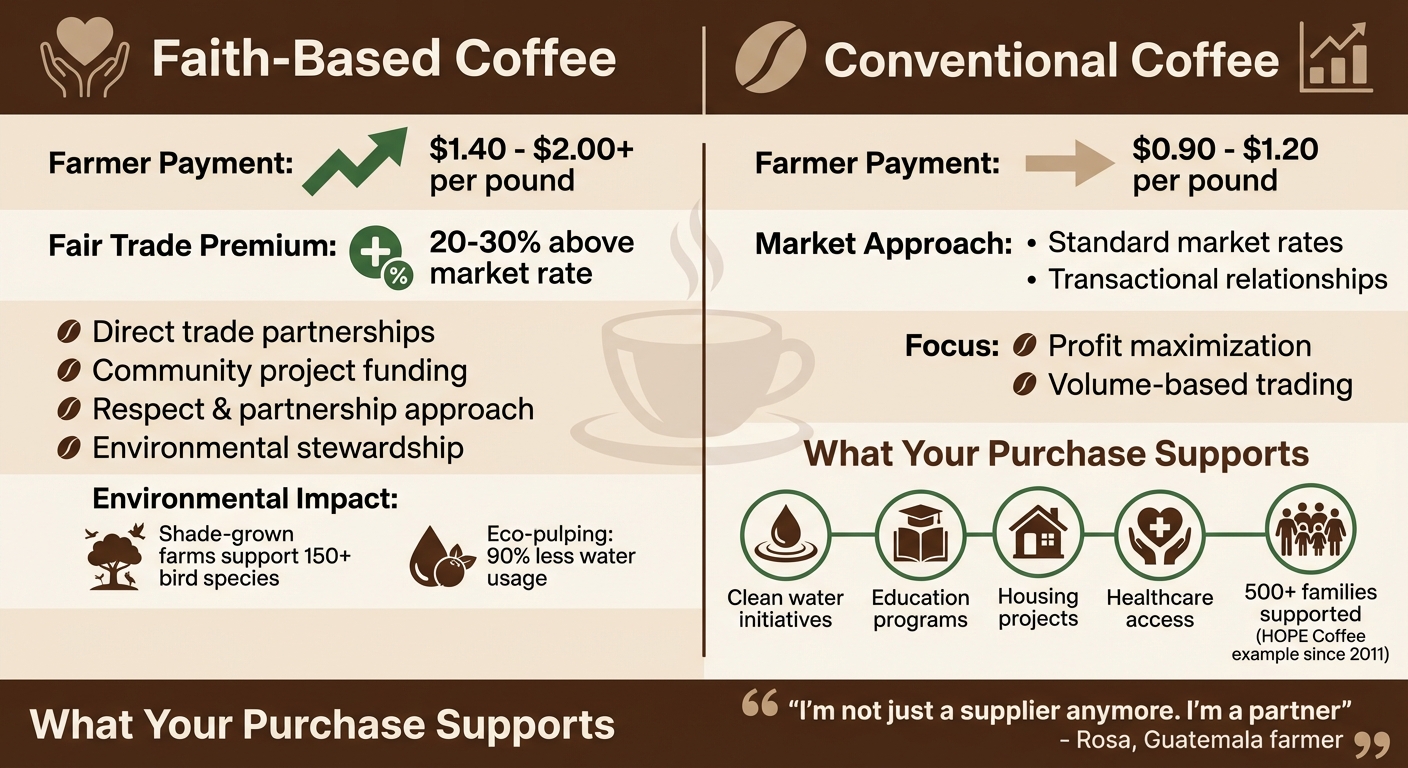
Faith-Based Coffee vs Conventional Coffee: Pricing and Impact Comparison
Ethical Sourcing and Stewardship
Biblical teachings play a key role in shaping coffee sourcing decisions. The directive in Proverbs to "speak up for those who cannot speak for themselves" and "defend the rights of the poor and needy" (Proverbs 31:8-9) inspires roasters to prioritize the well-being of farmers over maximizing profits. This isn't just about paying fair prices - it's about fostering genuine partnerships with coffee farmers.
Environmental responsibility also stems from this faith-driven perspective. Many faith-based roasters see themselves as caretakers of creation, supporting sustainable farming methods that preserve the earth for future generations. For instance, shade-grown coffee farms not only produce high-quality beans but also provide essential habitats for over 150 species of migratory birds. Additionally, eco-pulping techniques reduce water usage by 90% compared to traditional methods.
Nick Murphy of His Word Coffee captures this sentiment perfectly:
Creation care isn't a political issue for us. It's a theological one. Genesis tells us God entrusted humanity with stewarding the earth.
This dedication to environmental care aligns seamlessly with their commitment to building enduring, respectful relationships with coffee farmers.
Building Partnerships with Coffee Farmers
Faith-based roasters take ethical sourcing a step further by forging direct trade relationships that transcend mere business transactions. These partnerships are built on trust, respect, and a shared vision. Many roasters personally visit farms to ensure fair labor conditions and to cultivate relationships that endure far beyond a single harvest.
The results of these partnerships are tangible. For example, in May 2025, His Word Coffee paid farmers in Ethiopia’s Shakiso cooperative between $1.40 and $2.00+ per pound - well above the conventional market price of $0.90 to $1.20. This higher payment allows farmers to meet essential needs like healthcare and education, providing a more stable livelihood.
But the benefits go beyond financial gain. Rosa, a farmer from Guatemala's Huehuetenango region, shared:
The best part isn't even the better price. It's that buyers treat me with respect. They ask my opinion. They value my knowledge. I'm not just a supplier anymore. I'm a partner.
These long-term commitments empower farmers to plan and invest in their futures rather than merely scraping by from one harvest to the next. Some roasters even reinvest their profits into the community, funding projects like home construction, water filtration systems, and roof repairs in the areas where their coffee is grown.
Nonprofit Support in Faith-Based Coffee
How Coffee Purchases Support Nonprofits
Faith-based coffee companies often see their mission as more than just selling coffee - they use their business to make a difference. Guided by the principles of Micah 6:8, which calls for justice, mercy, and humility, many of these companies incorporate nonprofit support into their operations. This can take various forms, like donating all proceeds from specific products, setting aside a percentage of sales, or offering matching grants.
At Brown Boot Coffee, we’re proud to follow this mission-driven approach. Our signature blends, including Budaka Bold (a rich dark roast, $25.00) and Mayuge Morning (a smooth medium roast, $25.00), directly support Musana, a nonprofit working to uplift communities in Uganda. Every bag sold contributes to life-changing projects, making your purchase part of something bigger.
Just as ethical sourcing strengthens relationships with farmers, these nonprofit partnerships create opportunities for communities to thrive. The impact of these contributions goes far beyond financial aid, driving meaningful progress in underserved areas.
Community Impact Through Coffee Sales
The partnerships between faith-based coffee companies and nonprofits do more than provide funding - they help transform lives. Coffee sales support initiatives like Christ-centered education, access to clean water, and safe housing in coffee-growing regions. Every cup of coffee you enjoy plays a role in providing essential resources, building infrastructure, and supporting educational opportunities for communities in need.
Faith in Roasting and Business Operations
Roasting as Worshipful Work
At Brown Boot Coffee, roasting isn’t just about crafting coffee - it’s about honoring God through dedication and excellence. Every small batch is treated as a sacred opportunity, where attention to detail transforms a routine task into an act of worship. The beans are seen as gifts, and the roasting process is carried out with care and respect, ensuring each batch reflects the company’s high standards of stewardship.
This perspective gives deeper meaning to the work, elevating it beyond a business function. Roasting becomes a way to create something that honors both the resources entrusted to the company and the people who enjoy the final product. This philosophy of care and precision also carries over into their leadership style and ethical business practices.
Transparency and Integrity in Business
Brown Boot Coffee builds its operations on a foundation of faith, transparency, and integrity. Established in 2024 by Luke and Haley, the company’s mission is rooted in creating a positive impact. Luke explains their vision: "Brown Boot Coffee was started in 2024 with the desire to create a business that has a positive impact on its employees, customers, and the world around us (and not just say it)."
This "not just say it" approach means their values are backed by action. For example, their Budaka Bold roast ($25.00) directly supports Musana’s nonprofit efforts, creating a clear link between coffee sales and charitable work. The business embraces a straightforward identity - bold, hardworking, and honest - eschewing pretense in favor of authenticity.
Community-Centered Business Practices
Brown Boot Coffee’s mission extends beyond its internal practices to actively support the community. They create purpose-driven roasts that fund missions and local organizations. A notable example is their partnership with Young Life Cherry Creek Schools, where the "You Were Brewed For This" blend helps support local initiatives.
The company also celebrates its roots through blends like Clyde's Roast ($23.00) and Dick's Decaf ($20.00), which honor family heritage and personal values. Even the name "Brown Boot" reflects their ethos - it symbolizes the early riser, the disciplined worker, and the humble builder of community. To make their premium coffee more accessible, they offer free shipping on orders over $20.00, ensuring their mission-driven approach reaches as many people as possible while staying true to their core values.
Faith-Inspired Coffee Blends: Stories Behind the Roasts
Signature Blends with Purpose
At Brown Boot Coffee, every blend tells a story - one that intertwines personal heritage, faith, and a drive to honor creation. These signature roasts aren’t just about flavor; they’re about meaning.
Take the Bootstrap Blend ($20.00), for example. This founder’s blend marries natural Ethiopian and washed Colombian beans with a touch of hazelnut. It’s not just coffee - it’s a tribute to resilience and determination, qualities rooted in both entrepreneurship and faith. As the name suggests, it’s crafted to "steady your resolve" for whatever the day holds.
Then there’s the Bison Blend ($20.00), a bold roast featuring washed Mexican beans with hints of baking spice and molasses. This blend is all about strength and durability, celebrating those who value perseverance. Together, these blends show how faith and personal stories can transform a simple cup of coffee into something deeply meaningful.
Blends That Support Nonprofit Missions
Brown Boot Coffee doesn’t stop at storytelling - it extends its mission by using coffee as a tool for community impact.
Some roasts directly support nonprofit initiatives. For instance, Budaka Bold ($25.00) and Mayuge Morning ($25.00) contribute to Musana’s community development work. Every bag sold helps fund this nonprofit’s efforts, turning your morning coffee into a way to make a difference.
And then there’s the "You Were Brewed For This" blend, created in partnership with Young Life Cherry Creek Schools. Proceeds from this blend go straight to youth ministry programs. As founders Luke and Haley put it, "Every bag shares profits with nonprofits - at zero extra cost to you." These mission-driven blends are a testament to the belief that business can be a vehicle for service, spreading Christ’s love and strengthening communities with every sip.
Conclusion: The Impact of Faith-Based Coffee
Faith-based coffee goes beyond just being a beverage - it’s a way to make a difference. Farmers receive higher payments that help fund programs like clean water initiatives and education, creating opportunities for entire communities to thrive. By choosing coffee rooted in principles of care and responsibility, you're supporting fair wages, environmental stewardship, and community progress all at once. It’s a step toward meaningful, lasting change.
Fair Trade practices play a big role in this. Farmers involved in Fair Trade programs typically earn 20–30% more than those selling in traditional markets, with these premiums funding impactful community projects around the world. For example, HOPE Coffee has supported over 500 families since 2011, using after-tax profits to fund these life-changing efforts.
At Brown Boot Coffee, this same passion fuels every roast. Whether you’re enjoying the Bootstrap Blend ($20.00) or Budaka Bold ($25.00), each purchase contributes to nonprofit initiatives - at no extra cost to you. Your daily coffee routine becomes a way to support community development and honor the farmers behind the beans.
"By helping others, and having God at the center of it, we can lift people out of poverty all over the world."
Brad Fassbender’s words perfectly capture the mission behind faith-based coffee.
Every coffee purchase has the power to create change. When you choose blends that prioritize ethical sourcing, transparency, and a mission-driven approach, you’re investing in dignity, responsibility, and progress - one cup at a time. By weaving faith into every step of the process, this coffee not only satisfies but also uplifts communities worldwide.
FAQs
How do I know a coffee brand is truly faith-based?
To spot a genuinely faith-based coffee brand, pay attention to how their business reflects Christian principles. Look for signs like ethical sourcing, efforts to make a positive impact on communities, and a commitment to transparency. A true faith-driven mission often ties back to biblical values, with these brands emphasizing service to others. Many also share openly how their faith influences their work, aiming to support communities not just physically but spiritually as well.
Where do faith-based coffee profits go?
Profits from faith-based coffee often serve a dual purpose: supporting spiritual outreach and addressing community needs in coffee-growing regions. These funds are frequently directed toward initiatives such as providing clean water, building safe housing, improving education, or supporting medical missions - many of which are spearheaded by local churches. By blending financial success with Christian principles, these companies channel their earnings into real-world assistance and the sharing of the gospel, making their impact extend far beyond just the business itself.
Does paying farmers more raise coffee prices a lot?
Paying farmers higher wages - particularly through initiatives like living income pricing, which ensures farmers can cover their basic needs and combat poverty - can lead to higher coffee prices for consumers. That said, the extent of this impact on retail prices varies. It hinges on factors such as how the supply chain operates and broader market forces at play.