


5 Signs You're Buying High-Quality Specialty Coffee
Not all coffee is created equal. If you're paying premium prices, you want to make sure you're getting the best beans. High-quality specialty coffee stands out through measurable standards, clear sourcing, and attention to detail. Here's how to tell if your coffee is worth it:
- SCA Score: Specialty coffee scores 80+ on a 100-point scale, ensuring superior taste and quality.
- Origin Transparency: Look for farm names, altitude, and processing details.
- Roast Date: Check for a specific "Roasted On" date, not vague "Best By" labels.
- Certifications: Labels like Organic or Fair Trade indicate ethical and quality practices.
- Consistent Flavor: Top-grade beans have minimal defects and deliver reliable taste.
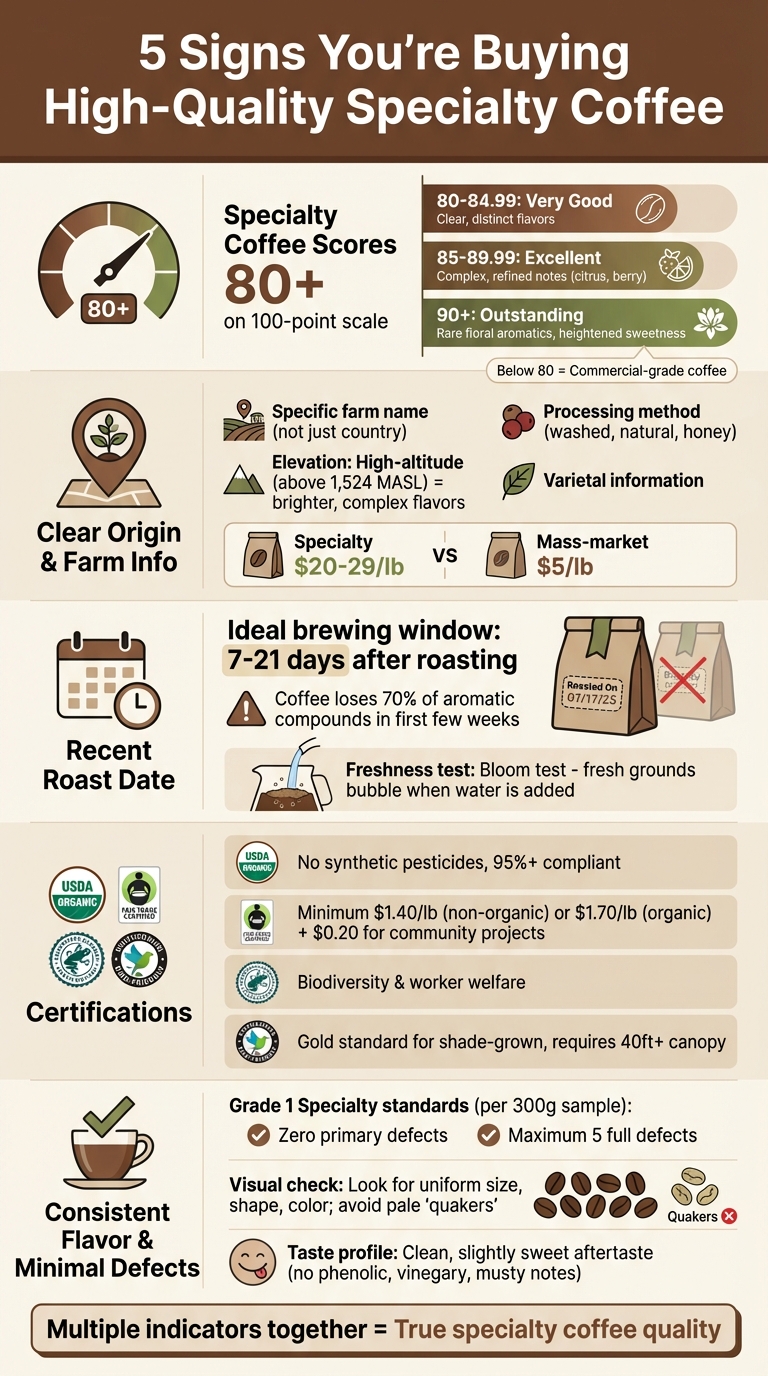
5 Quality Indicators of Specialty Coffee: SCA Scores, Origin Details, and Certifications
What Is Specialty Coffee? How It’s Graded, Grown & Why It’s Different
sbb-itb-c3999cb
1. SCA Quality Score of 80 or Higher
A specialty coffee earns its title by scoring 80 or above on the Specialty Coffee Association's (SCA) 100-point scale, a system designed to separate exceptional beans from everyday, commercial-grade options.
Certified Q Graders evaluate the coffee through a detailed cupping process, scoring ten attributes: fragrance/aroma, flavor, aftertaste, acidity, body, balance, uniformity, clean cup, sweetness, and overall impression. Each attribute is rated on a 10-point scale, ensuring a thorough assessment. Before even reaching this stage, the coffee must meet strict criteria, including zero primary defects (like sour or fully black beans) and no more than five secondary defects in a 12.3-ounce sample.
The scoring system breaks down like this:
- 80-84.99: "Very Good" coffee with clear, distinct flavors.
- 85-89.99: "Excellent" coffee with greater complexity and refined notes, such as citrus or berry.
- 90+: "Outstanding" coffee, offering rare floral aromatics and heightened sweetness.
Anything scoring below 80 is classified as commercial-grade coffee, often destined for supermarket shelves or instant coffee production.
When purchasing specialty coffee, look for the exact numerical score on the bag or the roaster's website. Trustworthy roasters typically provide this information alongside a Certificate of Analysis. As Ebru Coffee Co explains:
"If you're paying high-end prices but no one can tell you the score, origin, process, or harvest date, you're likely not drinking specialty coffee, no matter what the package says."
The score isn't just a number - it reflects the effort and care behind the coffee. For example, a coffee scoring 86 can cost two to four times more than one rated at 79. This price difference supports farmers who dedicate themselves to cultivating extraordinary beans.
Once you've considered the score, dive deeper into details like the coffee's origin and farm to confirm its quality.
2. Clear Origin and Farm Information
When it comes to specialty coffee, the best beans come with a story - specific farm names, precise elevations, and detailed processing methods. These details are more than just trivia; they reflect transparency and quality. A label that simply says "Product of Colombia" doesn’t tell you much about the coffee’s journey or its ethical impact. On the other hand, a bag that names the farm, shares the altitude, explains the processing method, and even mentions the varietal is a sign that you’ve got something special in your hands.
Traceability is a major indicator of quality. Coffees from single farms provide the clearest traceability and often the highest quality compared to those labeled by region or country. For instance, "Finca El Paraíso, Cauca, Colombia" shows a direct link between the roaster and the farmer, which speaks volumes about the effort behind the coffee. As Mathew Woodburn-Simmonds, Home Coffee Expert, puts it:
"A coffee with a single farm origin is probably better than a single region which is probably better than a single country".
Elevation is another detail to look for. High-altitude coffee (grown above 1,524 MASL - Meters Above Sea Level) tends to produce brighter and more complex flavors. Many premium coffee labels include this information, giving you a hint of the flavor profile before you even brew a cup.
The processing method is equally important. Whether the beans are washed, naturally processed, or honey-processed, this step significantly influences the coffee’s flavor. Washed coffees often deliver a clean, crisp taste, while natural-process beans lean toward a fuller body with bold fruit notes.
Pricing transparency is another critical factor. Ethical brands often disclose the FOB (Free On Board) or farmgate price, which reflects what farmers are actually paid. Specialty coffee typically costs between $20 and $29 per pound, far higher than the $5-per-pound price tag of mass-market coffee. This price difference ensures that farmers receive a fair share for their labor. As Kim Elena Ionescu, Director of Sustainability at the Specialty Coffee Association of America, explains:
"If your coffee is cheap, the environmental and working conditions are probably not good".
When roasters provide this level of detail, it’s more than just a sales pitch - it’s a commitment to quality and ethical practices. Transparency helps confirm that your premium coffee is worth the investment, laying the groundwork for other important markers like roast freshness.
3. Recent Roast Date
Freshness is the secret to unlocking the best coffee flavors. Once beans are roasted, they begin to degas and oxidize - two natural processes that directly influence their taste. A bag with a clear "Roasted On" date gives you an honest snapshot of where the beans are in their flavor journey. On the other hand, vague "Best By" dates often hide how long the coffee has been sitting on the shelf.
For specialty coffee, the ideal window for brewing is usually between 7 and 21 days after roasting. During this period, the beans have released enough CO₂ to ensure even water contact during brewing while still preserving their rich aromatics. Timing is everything because coffee can lose up to 70% of its aromatic compounds in the first few weeks after roasting. Brewing too soon (within three days) or too late (after 30 days) can lead to a disappointing cup with muted or off flavors.
Pete Cooper, Founder of Goldberry Roasting Company, puts it perfectly:
"Understanding how roast dates work is key to enjoying better flavor, longer shelf life, and a more consistent cup".
This is why specialty roasters proudly include the exact roast date on their packaging. It’s not just about transparency - it’s about ensuring you experience the coffee at its absolute best. This attention to detail reflects not only a commitment to flavor but also the ethical values behind specialty coffee production.
Much like knowing the origin of your beans, understanding roast freshness is a hallmark of quality. To make the most of your coffee, buy only what you can finish within two to three weeks. Store the beans in an airtight container at room temperature and grind them just before brewing to lock in their flavor. Want to check freshness yourself? Try the "bloom test": when you pour hot water over fresh grounds, they should bubble and rise. If the grounds stay flat, the coffee may have passed its prime.
A clear roast date ensures you're savoring coffee at the peak of its flavor potential.
4. Certifications Like Organic or Fair Trade
Certifications act as third-party assurances that coffee meets specific standards related to environmental care, social responsibility, and economic fairness.
USDA Organic is one of the most familiar certifications. To ensure authenticity, look for the official blue and green circular USDA Organic logo, rather than just a printed claim. This certification guarantees that the coffee is grown without synthetic pesticides, fertilizers, or GMOs, and that at least 95% of its ingredients comply with these standards. Beyond avoiding chemicals, organic farming focuses on improving soil health and encouraging biodiversity, which can contribute to more nuanced flavors.
Fair Trade Certified coffee ensures farmers are paid a minimum price - $1.40 per pound for non-organic coffee and $1.70 per pound for organic - along with an additional $0.20 per pound to support community projects like schools and clinics. Over 60% of consumers recognize the Fair Trade label, making it a trusted indicator of ethical sourcing. For example, in Costa Rica, communities with greater Fair Trade involvement saw a 3.5% increase in average household income.
Other certifications include Rainforest Alliance (identified by the green frog logo), which focuses on biodiversity and worker welfare, and Bird-Friendly certification from the Smithsonian, often regarded as the gold standard for shade-grown coffee. Bird-Friendly certification also requires USDA Organic certification and adherence to strict environmental criteria, such as maintaining a canopy height of at least 40 feet. If you spot multiple certifications - like Organic and Fair Trade - on a single bag, it reflects a deeper commitment to both quality and ethical practices.
These certifications not only highlight ethical and sustainable practices but also set the stage for the next key factor: consistent flavor with minimal defects.
5. Consistent Flavor and Minimal Defects
Consistency in flavor ensures that every cup delivers the same experience, whether it's from the same batch or a different purchase. This reliability is key to building trust with customers. When the flavor unexpectedly changes, customers often lose confidence and might quietly switch to another brand, impacting loyalty.
Achieving this consistency starts with flawless beans. For coffee to meet Grade 1 Specialty standards, a 300-gram sample must have zero primary defects and no more than five full defects overall. Primary defects - like fully black beans, fully sour beans, or fungal damage - are particularly harmful, as even one can ruin the flavor of an entire cup. Secondary defects, such as broken beans or minor insect damage, are less severe but can still lower quality when present in higher numbers.
A careful visual inspection can reveal much about bean quality. Under proper lighting, look for quakers - pale, peanut-colored beans that signal underdevelopment. These beans often taste flat or papery, hinting at poor sorting practices. Additionally, check for uniformity in size, shape, and color within the batch; inconsistencies often point to mixed-quality lots. Such visual consistency reinforces the trust established by other quality measures.
Taste is just as revealing. Off-flavors like phenolic, vinegary, musty, or grassy notes suggest lapses in quality control. In contrast, a clean, slightly sweet aftertaste is a hallmark of high-quality coffee. Harsh bitterness or an ashy sensation signals issues in the production process. These visual and taste evaluations lay the groundwork for more precise, professional assessments.
Professional roasters take additional steps to ensure consistency. They rely on Agtron color measurement to keep roast color within two points of their target, ensuring uniformity across batches. They also conduct blind cuppings under SCA protocols, involving trained professionals who evaluate the coffee in controlled settings. Rebecca Zaynidinova, Production Roaster at Penstock Coffee Roasters, highlights the importance of this process:
"Sensory data is best collected during a blind cupping, by several trained professionals in the same session, with the same set of samples".
Conclusion
Spotting high-quality specialty coffee becomes straightforward when you focus on these five key indicators. First, a high SCA score ensures rigorous grading standards. Second, clear origin details provide insight into where your coffee comes from. Third, a recent roast date helps preserve the coffee’s best flavors. Fourth, certifications point to ethical sourcing and production. Finally, consistent flavor reflects careful quality control. Together, these factors not only promise a better cup of coffee but also highlight the ethical and sustainable values behind your choice. As K Brew explains:
"When you learn to identify quality, you're not just improving your coffee experience - you're honoring the people and process behind it".
Before your next coffee purchase, look for a label that includes a specific "roasted on" date instead of a vague "best by" date, which could be as far as 18–24 months out. Also, ensure the origin details are clearly listed. While specialty coffee might cost a bit more, that price reflects the ethical sourcing and meticulous production processes mentioned here - from hand-picking beans to fairly compensating farmers. Plus, you’ll savor a cup with vibrant flavor notes like citrus, chocolate, or berries, rather than settling for dull, bitter coffee.
FAQs
Does a higher SCA score always taste better to me?
A higher SCA score doesn’t necessarily mean the coffee will taste better to you. Taste is deeply personal, and what one person loves - like a coffee's sweetness or its intricate flavor profile - might not appeal to someone else. While the score highlights quality, your enjoyment ultimately hinges on your own flavor preferences.
How can I tell if a coffee’s origin info is truly traceable?
To spot coffee that’s genuinely traceable, look for detailed records of its path through the supply chain. This includes specifics about the farm where it was grown, the processing methods used, and how it was distributed. Such transparency not only guarantees accountability but also verifies the coffee’s quality and origin.
What’s the best way to store beans to keep them fresh?
To keep your coffee beans fresh, store them in an airtight, opaque container and place it in a cool, dark spot. This safeguards the beans from exposure to oxygen, light, heat, and moisture, all of which can dull their flavor. Steer clear of storing beans in the refrigerator or freezer unless you're dealing with a large batch intended for long-term storage. For the freshest taste, purchase small quantities of freshly roasted beans and use them quickly.