


7 Benefits of Buying Purpose-Driven Coffee Brands
Your morning coffee can do more than wake you up - it can create a positive impact. Purpose-driven coffee brands focus on fair farmer pay, ethical sourcing, and community support, turning your daily habit into a force for good. Here’s what you gain when you choose these brands:
- Support for Nonprofits: A portion of sales funds clean water projects, education, healthcare, and more.
- Alignment with Values: Reflect personal or faith-based principles in your purchases.
- Fair Farmer Compensation: Farmers earn 20–30% more, improving their quality of life.
- Environmental Care: Practices like shade-grown coffee protect ecosystems and wildlife.
- Community Development: Profits support schools, clinics, and clean water systems.
- Personal Fulfillment: Feel good knowing your choice contributes to meaningful change.
- High-Quality Coffee: Ethical sourcing leads to richer, better-tasting blends.
Cost Difference? Minimal. Brewing ethically sourced coffee at home costs $0.75–$0.85 per cup, far less than a coffee shop drink. Your choice doesn’t just deliver better coffee - it supports farmers, protects nature, and uplifts communities.
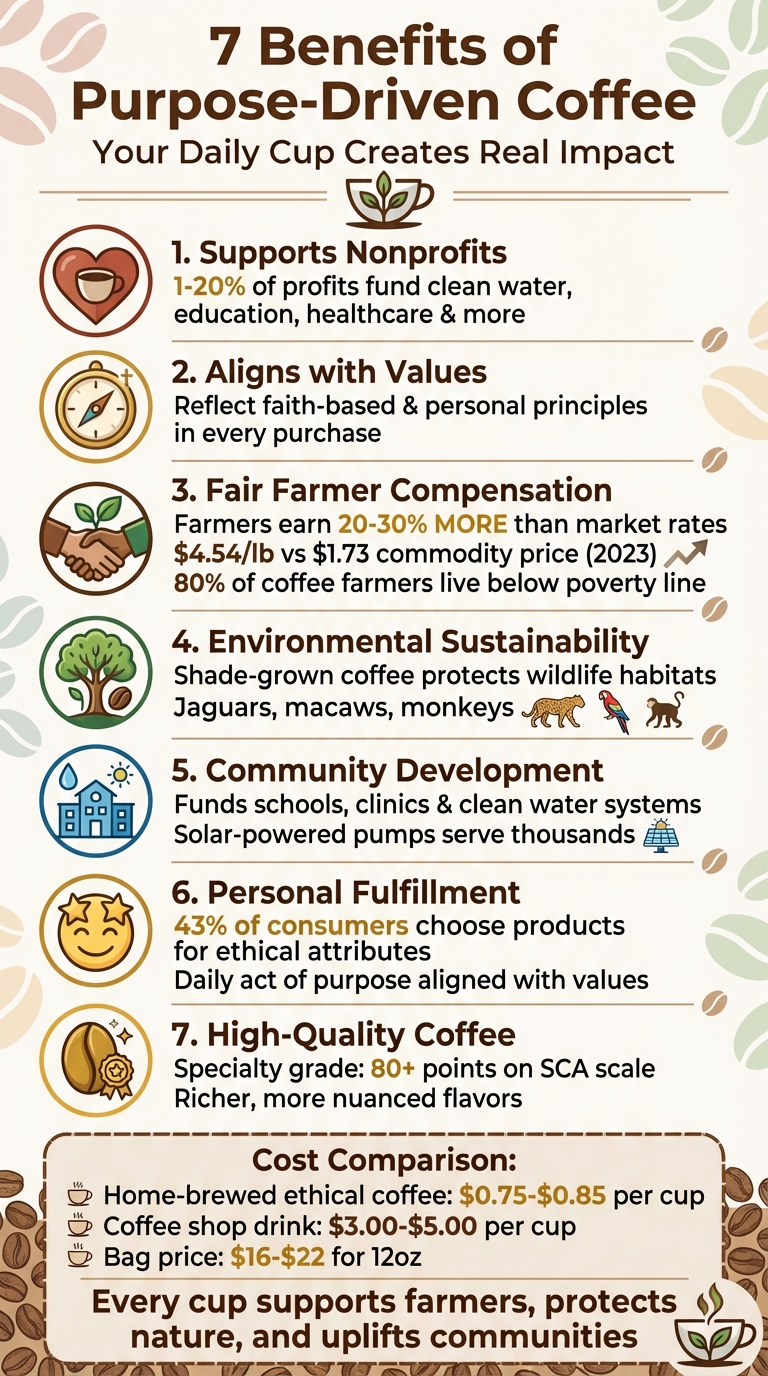
7 Benefits of Purpose-Driven Coffee: Impact by the Numbers
Ep 1 - Why Two Friends & a Coffee Brand with Purpose Care About Climate
sbb-itb-c3999cb
1. Supports Nonprofit Organizations with Every Purchase
With every cup of Brown Boot Coffee, you're contributing to nonprofit initiatives. A portion of each sale automatically goes to nonprofit organizations, meaning you’re helping important causes without spending anything extra.
The company dedicates a fixed amount per bag or a percentage of gross profits (ranging from 1% to 20%) to fund efforts like clean water projects, medical missions, farmers' housing, animal rescue, youth mentorship, disability services, and environmental programs.
So, while you enjoy the rich flavors of Brown Boot Coffee, you’re also helping to create real, meaningful change in communities. It’s coffee that not only tastes great but also reflects values that matter.
2. Aligns Purchases with Faith-Based Values
At Brown Boot Coffee, we believe that every purchase can reflect personal faith and values. For many Christians, shopping isn't just about transactions - it's about living out their beliefs. That’s why we approach our work as an act of worship, focusing on stewardship rather than profit. One way we do this is by paying farmers 20–30% more than conventional market rates, ensuring they earn a fair wage for their hard work and dedication.
Our commitment doesn’t stop there. Through a model of servant-evangelism, we dedicate profits to initiatives that address essential needs, like clean water and safe housing, while also sharing the Gospel. By choosing our coffee, you're not just buying a product - you’re supporting a mission that extends far beyond the cup.
With every sip, you’re aligning your values with your actions, enjoying high-quality coffee while contributing to projects that uplift people and care for creation.
3. Promotes Ethical Sourcing and Fair Farmer Compensation
Choosing purpose-driven coffee goes beyond just enjoying a good cup - it’s about supporting ethical sourcing and ensuring farmers are fairly compensated. In traditional coffee markets, a staggering 80% of coffee farmers live below the poverty line. Purpose-driven brands aim to change this reality by treating farmers as true partners and ensuring they earn a living income.
Fair Trade premiums typically add about $0.20 per pound for conventional coffee. However, some purpose-driven roasters go above and beyond. For instance, in 2023, one ethical brand paid an average of $4.54 per pound - almost three times the commodity market price of $1.73. This extra income allows farmers to cover basic needs like housing, healthcare, education, and food, creating a ripple effect that improves their overall quality of life. In addition to securing livelihoods, these premiums enable farmers to adopt practices that benefit both their communities and the environment.
Direct trade relationships play a key role in this transformation. By working directly with farming cooperatives and cutting out intermediaries, purpose-driven brands ensure farmers receive consistent financial support. These long-term partnerships allow farmers to invest in better tools, sustainable farming techniques, and community projects, fostering stability and growth.
"The best part isn't even the better price. It's that buyers treat me with respect. They ask my opinion. They value my knowledge. I'm not just a supplier anymore. I'm a partner."
– Rosa, Coffee Farmer in the Huehuetenango Region, Guatemala
When farmers earn a living wage, they can focus on quality practices like selective harvesting, improved processing, and shade cultivation. The result? The rich, complex flavors you love in specialty coffee, paired with a positive social and environmental impact. Purpose-driven coffee isn’t just about great taste - it’s about making a difference.
4. Advances Environmental Sustainability and Stewardship
Purpose-driven coffee brands are making strides in environmental responsibility by adopting practices that protect ecosystems and reduce their carbon footprint. These efforts often go beyond the basics, actively working to restore natural resources.
One standout approach is the use of shade-grown and organic farming techniques. Growing coffee under native trees not only prevents deforestation but also creates vital habitats for wildlife like jaguars, macaws, and monkeys. Farmers also steer clear of synthetic nitrogen fertilizers, which emit greenhouse gases, and instead enrich the soil with organic materials like animal manure and coffee pulp. These farming methods lay the groundwork for broader sustainability efforts across their operations.
Some brands are pushing the envelope with innovative energy solutions. For example, Stumptown Coffee Roasters recycles roasting heat, Stone Creek Coffee relies on wind power, and Cafenor achieved carbon-neutral certification by using renewable energy sources. In 2012, Stumptown installed a Regenerative Thermal Oxidizer (RTO) at its Portland, Oregon roastery, cutting emissions almost entirely. Meanwhile, Cafenor in El Salvador built a wind and solar-powered mill in Metapan in 2020, leveraging the area's microclimate to achieve carbon neutrality.
Packaging is another area where these brands are making an impact. Purity Coffee started transitioning to recyclable plastic with over 50% post-consumer content in 2022, aiming for its entire product line to be fully recyclable by mid-2024.
"Environmental sustainability has become a core principle of Purity, and the regenerative organic movement is our guide. It is holistic, involving soil health, biodiversity, animal welfare, and fair wages and working conditions." – Andrew Salisbury, Founder of Purity Coffee
These efforts don’t just reflect environmental values - they translate them into tangible results while maintaining the high quality consumers expect.
5. Contributes to Community Development Initiatives
Some coffee brands go beyond just selling a product - they use their profits to support programs that uplift coffee-growing communities. By addressing critical needs like clean water, education, healthcare, and economic opportunities, these initiatives aim to create a lasting impact far beyond the coffee harvest.
At Brown Boot Coffee, we’ve taken this mission to heart. A portion of every purchase goes directly into community projects designed to improve lives. For example, we’ve funded Water, Sanitation, and Hygiene (WaSH) projects in coffee-growing areas, installing solar-powered pumps and piping systems to provide clean water to schools and clinics. These efforts bring reliable access to clean water for thousands of people. Beyond water, we’ve also invested in programs that enhance education and healthcare, reaching communities that previously lacked these essential services.
Education is a cornerstone of these efforts. By supporting schools that offer multilingual education and agricultural training, we help prepare the next generation with both academic knowledge and practical skills. This dual focus equips students to contribute meaningfully to their communities. Healthcare is another priority. Recent projects have introduced emergency dental care and medical services to areas where families previously had no affordable options for treatment.
"By connecting coffee drinkers and coffee farmers for the first time and leveraging the power of community-level impact, Bellwether and its roaster partners are creating a sustainable future for the coffee industry with every pound roasted." – Alex Bravo, Impact Manager, Bellwether Coffee
In addition, every bag of coffee sold supports programs like youth mentoring, disability services, and vital infrastructure projects. These initiatives aren’t just short-term fixes - they create ripple effects that benefit generations. With every cup of coffee, you’re helping to build stronger, healthier communities.
6. Enhances Personal Fulfillment Through Value-Driven Choices
Your morning coffee can be more than just a caffeine fix - it can be a daily act of purpose. Supporting ethical practices transforms your coffee ritual into something meaningful, connecting you to the stories of farmers, communities, and causes you care about. This isn't about guilt or obligation; it's about the genuine satisfaction that comes from aligning your everyday habits with your personal values.
In fact, research shows that 43% of global consumers choose products for their ethical attributes, often experiencing a "warm glow" when their purchases reflect their values. It's not just about feeling good in the moment, though. Studies suggest that making choices in line with personal values contributes to self-actualization, a vital component of long-term happiness. By choosing ethically sourced coffee, you’re not only supporting local communities but also enriching your own sense of purpose. At Brown Boot Coffee, for instance, every bag purchased helps fund nonprofit organizations - at no additional cost to you - turning your morning cup into something much bigger.
For those guided by faith, this practice can take on even deeper meaning. It becomes a daily reminder of stewardship, caring for creation, and upholding human dignity.
"Every purchase is a vote for the kind of world you want to live in." – Nick Murphy, Founder, His Word Coffee
And here's the kicker: ethically sourced specialty coffee doesn’t have to break the bank. A 12oz bag typically costs $16 to $22, which translates to just $0.75 to $0.85 per cup when brewed at home. Not only does this ensure farmers earn 20–30% more income, but it’s also far cheaper than the $3 to $5 you’d spend on a coffee shop drink. So, with every cup, you’re not just savoring high-quality coffee - you’re actively participating in a system that values human dignity and drives meaningful change. That sense of personal fulfillment pairs perfectly with the exceptional taste of specialty blends.
7. Ensures High-Quality Specialty Coffee Blends
Ethical sourcing doesn’t just benefit farmers - it also raises the bar for coffee quality. By paying farmers between $1.40 and $2.00 per pound - far above the usual $0.90 to $1.20 - they gain the resources to improve their equipment, fine-tune fertilization and pruning methods, and focus on harvesting only the ripest coffee cherries. These steps directly contribute to richer, more nuanced flavors in every cup.
Specialty coffee, by definition, must score 80 points or higher on the Specialty Coffee Association scale. Brands with a purpose consistently hit this mark because they prioritize long-term partnerships with farmers, fostering direct collaboration between growers and roasters. This commitment to quality is further amplified by sustainable growing practices.
"When producers are empowered and supported, they're able to invest more in quality - leading to the complex, clean, and memorable cups our community enjoys every day." - Karl Fisher, Alabaster Coffee
Take shade-grown coffee, for instance. This method allows cherries to ripen slowly under a natural canopy, resulting in denser beans packed with concentrated sugars and intricate flavors.
Brown Boot Coffee exemplifies these principles in every blend. Whether you’re savoring Clyde's Roast or pulling a shot of Hank's Espresso, you’re tasting the results of ethical sourcing paired with expert craftsmanship. It’s proof that purpose-driven practices can deliver exceptional quality in every sip.
Conclusion
Every cup of coffee you brew is more than just a drink - it's a choice that can make a difference. Purpose-driven brands turn your daily routine into something meaningful, supporting nonprofit initiatives, ethical practices, and better living conditions for coffee-growing communities. With each purchase, you're contributing to a ripple effect that extends far beyond your kitchen.
Brown Boot Coffee is a perfect example of this philosophy in action. Every blend they offer combines exceptional quality with a commitment to values, delivering coffee that not only tastes great but also stands for something bigger.
So, the next time you pour your morning cup, think about the impact you're making. You're not just enjoying premium coffee - you’re supporting a system built on integrity, community, and purpose.
FAQs
How can I verify a coffee brand’s impact claims?
To verify a coffee brand’s claims about its impact, look for third-party certifications such as Fairtrade, Rainforest Alliance, or B Corp. These certifications indicate that the brand meets certain ethical and environmental standards. Additionally, review the brand's sourcing practices and seek out independent analyses or impact reports from trusted organizations. These resources offer clarity and help confirm whether the brand truly upholds ethical and sustainable practices.
What should I look for to know farmers are paid fairly?
To make sure farmers are receiving fair compensation, watch for signs like Living Income Pricing, which ensures they earn enough to meet their basic needs. Also, look for clear transparency about how funds are invested in farming communities. This could include direct cash payments to farmers or community funds aimed at supporting their families and improving their quality of life.
Does purpose-driven coffee taste different than regular coffee?
Purpose-driven coffee doesn’t inherently taste different from regular coffee. The flavor is primarily influenced by factors such as the bean variety, how it's processed, and the brewing method used. That said, coffee grown using ethical and responsible practices often results in higher-quality beans, which can lead to richer flavor profiles and a more enjoyable cup.