


The Ultimate Guide to Supporting Causes Through Coffee
Your daily coffee habit can do more than just fuel your mornings - it can create meaningful change. By choosing ethically sourced coffee from purpose-driven brands, you can:
- Ensure farmers earn 20–30% more than market rates, breaking cycles of poverty.
- Support community projects like schools, healthcare, clean water systems, and roads.
- Promote eco-friendly farming practices like reduced pesticide use and shade-grown cultivation.
Faith-based and mission-driven coffee brands, such as Brown Boot Coffee, take it a step further by integrating values like stewardship and justice into their operations. For example, blends like Budaka Bold and Mayuge Morning fund community development efforts in Uganda, while others support youth outreach and global missions.
Whether you're an individual or a business, switching to ethically sourced coffee can align your purchases with your values. Look for certifications like Fair Trade or USDA Organic, research brand missions, and consider hosting coffee fundraisers to amplify your impact. Every cup can contribute to fair wages, better living conditions, and community growth. Make your coffee count.
How Fairtrade Is Supporting Coffee Farmers for a More Sustainable Future
sbb-itb-c3999cb
Why Support Causes Through Specialty Coffee
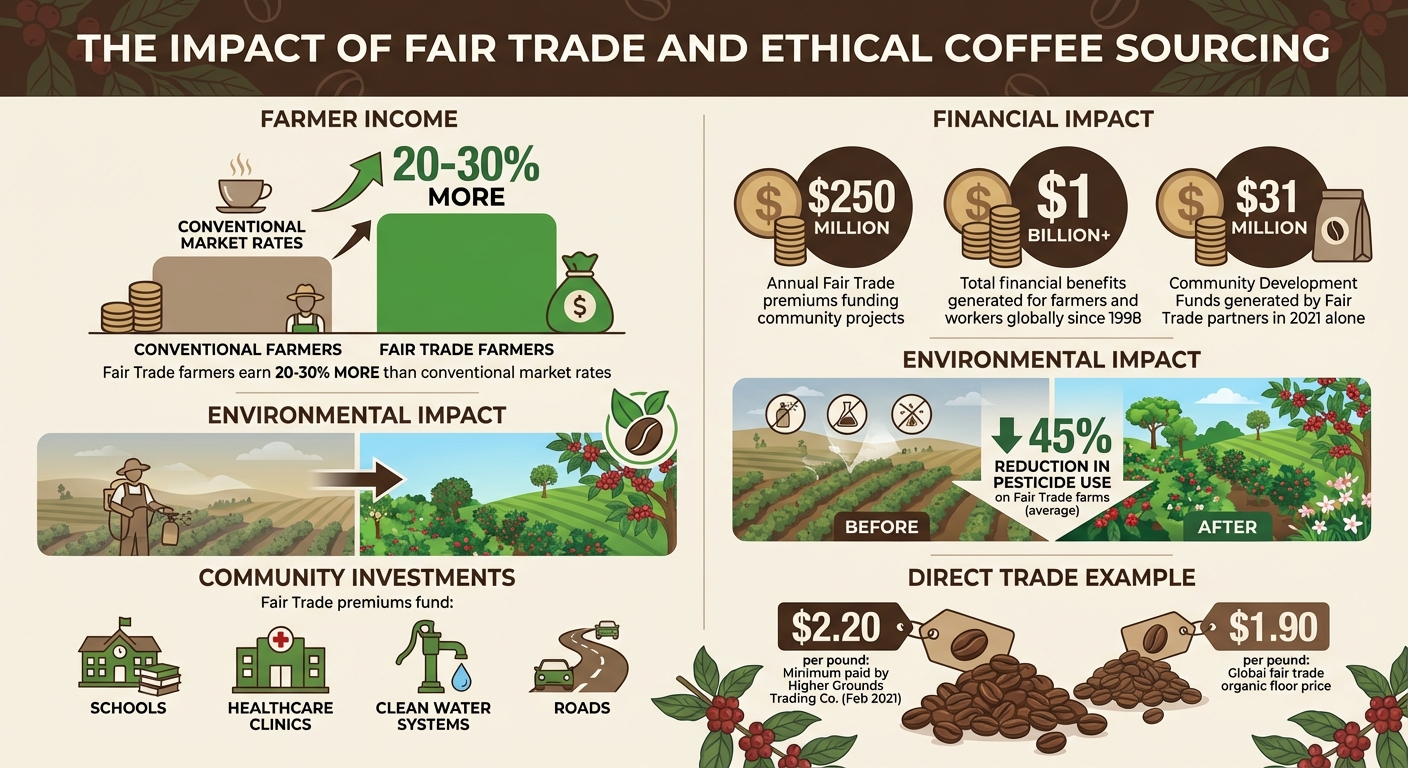
The Impact of Fair Trade and Ethical Coffee Sourcing
The Impact of Ethical Sourcing
Ethically sourced coffee does more than just ensure a better cup of coffee - it guarantees fair wages for farmers. Fair Trade farmers, for instance, earn 20–30% more than the conventional market rate, breaking long-standing cycles of poverty and helping them provide for their families.
But the benefits don't stop at individual earnings. Fair Trade premiums, which total $250 million annually, fund critical community projects around the world. These investments help build schools, healthcare clinics, clean water systems, and roads, transforming entire regions. Since 1998, Fair Trade Certified coffee alone has generated over $1 billion in financial benefits for farmers and workers globally.
The environmental impact is just as compelling. Fair Trade farms report an average 45% reduction in pesticide use, which safeguards both the land and the workers. These practices not only protect the environment but also ensure that farming communities can thrive for generations. It's about more than just economic stability - it's about creating a legacy of responsibility and care.
At its core, supporting ethically sourced coffee reflects a commitment to values that resonate deeply with faith and purpose.
Connecting Faith and Purpose in Coffee
Ethical sourcing isn’t just a business decision - it can also be a spiritual one. By choosing ethically sourced coffee, you turn an everyday habit into an act of stewardship. It’s a way to honor the dignity of every person in the supply chain, recognizing their worth and ensuring they are treated with fairness and respect.
"Our Christian faith shapes every aspect of His Word Coffee. We believe Scripture calls us to stewardship of creation, justice for workers, honesty in business, and generosity toward those in need." - Nick Murphy, Founder, His Word Coffee
Faith-based coffee roasters take this mission even further. For example, HOPE Coffee has used 100% of its after-tax profits since 2011 to support over 500 families in Honduras and Mexico. These funds have gone toward building homes, installing roofs, and providing water storage systems - all through partnerships with local churches. When you buy from these roasters, your coffee purchase directly contributes to global missions and community development.
This powerful blend of ethics and faith is fueling new movements within the coffee industry.
Trends in Cause-Driven Coffee
The specialty coffee world is evolving, with consumers demanding more transparency and accountability. People want to know exactly where their coffee comes from - not just the country, but the specific farm or cooperative. In response, brands are including detailed origin information on their packaging, such as altitude, coffee varietals, and processing methods, to build trust with informed buyers.
Direct trade is also gaining traction. By cutting out middlemen, roasters ensure that farmers receive a greater share of the profits. Higher Grounds Trading Co., for instance, paid a minimum of $2.20 per pound for all certified coffees through their co-owned importer, Cooperative Coffees, in February 2021. This was well above the $1.90 global fair trade organic floor price. Such partnerships treat farmers as collaborators rather than mere suppliers.
Social impact is becoming a key part of product offerings as well. Take La Colombe, which pledged $300,000 to the ACLU between November 2022 and May 2024. They donate $2 from every box of their Lyon specialty blend to support civil rights initiatives. These cause-driven blends make it easy for consumers to contribute to meaningful missions with every purchase, turning coffee into a vehicle for change.
How Individuals Can Support Causes Through Coffee
Your daily coffee habit can be more than just a morning pick-me-up - it can be a way to make a real difference. By aligning your coffee choices with purpose-driven values, you can support meaningful causes and create a positive impact in communities around the world.
Partner with Nonprofit Coffee Roasters Like Brown Boot Coffee
Consider buying from roasters that prioritize giving back. For instance, Brown Boot Coffee channels a portion of every purchase toward nonprofit organizations - without any extra cost to you. With blends like Budaka Bold and Mayuge Morning, your morning brew becomes a small but impactful act of generosity. Supporting roasters like these ensures that your coffee not only tastes good but also contributes to important community programs.
Choose Ethically and Sustainably Produced Beans
When shopping for coffee, look for labels that highlight ethical practices. Certifications such as Fair Trade, Rainforest Alliance, USDA Organic, or B Corp ensure that farmers are paid fairly and that some profits are reinvested into their communities. Labels like Direct Trade signify strong, personal relationships with farmers, cutting out middlemen and ensuring producers keep more of their earnings. These choices help promote sustainability while supporting the livelihoods of those who grow your coffee.
Use Coffee Purchases to Support Specific Initiatives
Some coffee blends are specifically tied to charitable efforts. For example, blends supporting organizations like Musana in Uganda turn every cup you drink into a way to back vital community projects. By choosing these mission-focused options, you're not just enjoying coffee - you’re contributing to efforts that align with faith-driven values and a commitment to helping others.
How Businesses Can Support Causes Through Coffee
Businesses have an opportunity to turn their coffee programs into a force for good, weaving social responsibility into daily routines. Brown Boot Coffee exemplifies this approach, and here are some practical ways your business can follow suit.
Offer Purpose-Driven Blends in Your Business
Choosing mission-focused coffee blends can transform everyday purchases into meaningful contributions. For example, Brown Boot Coffee offers blends like Bison Blend and Hank's Espresso, where every purchase supports nonprofit organizations. If you're buying in bulk, wholesale options make it easier to give back while saving money. Discounts typically range from 25% to 30% - orders of 100 to 249 units qualify for 25% off, while orders of 500 or more enjoy a 30% discount off retail pricing. This setup allows businesses to repurpose the savings toward causes that resonate with their values, all while serving excellent coffee.
Another option to consider is a consignment model. Here, the supplier provides the inventory, and your business earns a commission - usually around 25% - on every sale. It’s a low-risk way to offer products that align with shared values while generating additional revenue.
Host Coffee Fundraisers for Community Impact
Coffee fundraisers are a simple yet effective method to rally your community around a cause. Given that about 80% to 81% of American adults drink coffee daily, there's already a built-in audience for your efforts. To keep things manageable, limit your offerings to one medium roast, one dark roast, and a decaf option. Since 75% of fundraising customers prefer ground coffee over whole beans, catering to these preferences can boost sales.
Personalized branding adds a special touch. A custom 4×4-inch label featuring your organization’s logo or mission statement makes the product feel unique and connected to your cause. A two-week sales window works well, with an additional five to ten days set aside for roasting and distribution. For faith-based organizations, hosting a "Coffee & Prayer" event can effectively introduce both the coffee and the mission behind it.
Fundraisers also provide a solid financial return. With profit margins ranging from 25% to 50% of the retail price and suggested resale prices between $15.00 and $20.00 per bag, your organization could earn $3.75 to $10.00 in profit per bag sold. It’s a win-win: your community gets great coffee, and your cause gains crucial support.
Brown Boot Coffee's Mission-Driven Blends
Founded in 2024 by Luke and Haley, Brown Boot Coffee combines a love for specialty coffee with a mission to spread Christ's love and make a meaningful difference. As Luke shares, "Our founder, Luke, has always had a passion for coffee, adventure, entrepreneurship, and building genuine relationships, and he thought that this was the perfect opportunity to combine his passions and spread the love of Christ." This faith-driven purpose is infused into every blend, with specific roasts supporting charitable organizations and causes. Each cup not only delivers exceptional flavor but also supports a greater mission.
Their mission-driven blends are priced at $25.00 and directly contribute to impactful causes. For example:
- Budaka Bold: A bold dark roast that supports Musana's community development efforts in Uganda. Every sip helps fuel life-changing mission work.
- Mayuge Morning: A medium roast designed to "wake up to possibility" while also supporting Musana's initiatives in Uganda.
- You Were Brewed For This: Created in partnership with Young Life Cherry Creek Schools, this blend supports youth outreach programs, helping young people grow in faith and community.
Beyond these cause-specific blends, Brown Boot Coffee offers a variety of everyday options that maintain their commitment to quality and impact. These include:
- Bison Blend ($20.00): A dark roast with rich notes of baking spice and molasses, crafted to reflect the brand's overall mission.
- Bootstrap Blend ($20.00): The founder's blend, featuring hazelnut undertones from a mix of natural Ethiopian and washed Colombian beans.
- Clyde's Roast ($23.00): A light roast with a sweet, tangy profile.
- Hank's Espresso ($21.00): A cocoa-forward espresso with a hint of sweetness.
- Dick's Decaf ($20.00): A medium roast decaf option for those looking to enjoy coffee without the caffeine.
Every purchase supports Brown Boot Coffee's mission of fostering genuine relationships and honoring God's creation.
| Blend | Price | Roast Type | Supported Cause | Flavor Notes |
|---|---|---|---|---|
| Budaka Bold | $25.00 | Dark Roast | Musana (Uganda) | Bold; fuels mission work |
| Mayuge Morning | $25.00 | Medium Roast | Musana (Uganda) | "Wake up to possibility" |
| You Were Brewed For This | $25.00 | Not Specified | Young Life Cherry Creek Schools | Collaboration blend for youth ministry |
| Bison Blend | $20.00 | Dark Roast | General Brand Mission | Baking spice, molasses |
| Bootstrap Blend | $20.00 | Founder's Blend | General Brand Mission | Hazelnut; Natural Ethiopian & Washed Colombian |
| Clyde's Roast | $23.00 | Light Roast | General Brand Mission | Sweet with a touch of tang |
| Hank's Espresso | $21.00 | Espresso | General Brand Mission | Cocoa forward with subtle sweetness |
| Dick's Decaf | $20.00 | Medium Roast | General Brand Mission | Decaf option |
How to Identify Cause-Driven Coffee Brands
Choosing coffee that aligns with your values means understanding how brands contribute to meaningful causes. Here's how to make informed decisions.
Look for Transparency and Certifications
Certifications can reveal a lot about a brand's commitment to ethical practices. For instance, Fair Trade Certified ensures a minimum price for farmers and funds community projects. Since 1998, this certification has supported farming communities, and in 2021 alone, Fair Trade partners generated $31 million in Community Development Funds. It's no surprise that over 60% of consumers recognize and trust the Fair Trade label.
Another important certification is USDA Organic, which guarantees coffee is grown without synthetic pesticides or fertilizers, promoting healthier soil and ecosystems. For the most rigorous environmental standards, look for Smithsonian Bird-Friendly certification. This label requires both organic farming practices and specific shade-grown canopy standards, such as a canopy height of at least 40 feet with 11 or more tree species per hectare. Additionally, B Corp Certification signifies that a company meets high social and environmental performance standards across its entire operation, not just for individual products.
Be cautious with terms that lack regulation. As Kim Elena Ionescu, Director of Sustainability at the Specialty Coffee Association of America, points out:
"The words 'direct trade' are not regulated at all. So each company can define that term differently, and there's no body that determines what is and is not direct trade".
If you encounter claims like "shade-grown" without certification, verify their legitimacy by checking for recognized labels. Beyond certifications, explore the brand's mission and partnerships to see how they back up their claims.
Research Brand Missions and Partnerships
Certifications are a great start, but a deeper look at a brand's mission and partnerships can reveal its true impact. Check whether the brand specifies donation amounts - such as 15% of all sales instead of vague terms like "net profits" - and if they name the organizations they support. For example, North Arrow Coffee Company has donated over $13,340 to pro-life causes as of February 2026, directly contributing to saving 135+ babies and supporting 260+ families through its partnerships.
Brands that focus on building meaningful partnerships rather than chasing widespread reach often make a bigger difference. HOPE Coffee, for instance, uses a Direct Trade model to pay farmers in Honduras and Mexico above Fair Trade rates. All profits are reinvested in service projects led by local Christian churches. Faith-based brands often ground their work in principles like stewardship or human dignity, which shape their entire business model.
Transparency in finances is equally important. Look for brands that publish annual impact reports or disclose "farmgate prices", which show the actual amount farmers receive. Tools like the Fair World Project's 5-star rating system can help you evaluate brands based on their mission, ownership structure, and financial transparency. This level of detail helps separate brands with genuine commitments from those relying on empty marketing claims.
Integrating Faith-Based Values into Coffee Decisions
Your coffee choices can reflect principles like stewardship, justice, and community support that align with biblical teachings. By being intentional with your purchases, you can support missions and promote fair practices that mirror these values.
Choose Brands with Shared Values
Christian coffee brands differ in how they incorporate faith into their operations. Some are Christian-owned, while others weave faith into every part of their business. As Faith and Fellowship Review explains:
"A truly faith-based business doesn't just use Christian language - it demonstrates consistency between belief, transparency, and fruit."
Look for brands whose missions align with Scripture, such as those inspired by Micah 6:8, which calls for justice and mercy. For example, Brown Boot Coffee integrates Christian principles into its operations, ensuring fair treatment and compensation for farmers while supporting nonprofit organizations. These practices reflect biblical values of fairness and dignity. By choosing such brands, your coffee budget can become a practical way to support mission work.
Support Local and Global Missions Through Coffee
What if your daily coffee habit could directly fund Kingdom work? A brand that donates 10% of its sales could contribute over $80 annually to missions, based on average coffee consumption.
Many faith-based coffee brands channel their profits into impactful initiatives, including church planting, evangelical outreach, clean water projects, medical missions, and addiction recovery programs. For instance, one mission-driven program has supported over 500 families since 2011 by building homes and installing water systems in Honduras and Mexico. Churches can expand this impact by choosing mission-focused coffee for hospitality, turning their coffee budget into a tool for global outreach. Similarly, businesses can create a "missions hub" at their coffee stations to share stories about the causes their coffee supports.
Conclusion: Making a Difference One Cup at a Time
Every cup of coffee you drink has the potential to fuel meaningful change. Your choice of coffee reflects your values. By opting for Direct Trade or Fair Trade options and supporting roasters with a mission, you help ensure farmers are paid fairly - often earning 20–30% more than typical market rates. These choices also contribute to funding essential community projects like schools, healthcare facilities, and clean water systems.
Certifications can serve as a helpful guide when selecting coffee. Aligning your purchases with ethical and faith-based principles transforms a simple daily habit into an act of stewardship. By choosing ethically sourced coffee, your routine becomes a way to make a tangible difference.
Brands like Brown Boot Coffee take this mission to heart with blends such as Budaka Bold and Mayuge Morning. Every purchase supports nonprofit initiatives, funds community projects, and upholds the dignity of farmers. Whether you’re an individual looking to align your daily coffee ritual with your faith or a business striving to integrate purpose into your operations, these blends offer a meaningful way to start.
Subscriptions are another way to provide consistent support for farmers and mission-driven projects. Churches and businesses can amplify this impact by hosting coffee fundraisers, switching to Fair Trade options for hospitality, or creating a dedicated "missions hub" at coffee stations to share stories about the causes their coffee supports.
Your coffee habit can be more than just a routine - it can be an act of stewardship, justice, and solidarity. Each cup becomes a vote for fair wages, better living conditions, and community growth. Make your daily coffee count by choosing options that empower others and reflect your values.
FAQs
How can I verify a coffee brand’s impact claims?
When evaluating a coffee brand's claims about its impact, start by examining their sourcing transparency. Do they share details about where and how their coffee is sourced? Certifications such as Fairtrade, Rainforest Alliance, or Organic can also provide some assurance of ethical practices and environmental care.
Additionally, check if the brand publishes impact reports. These documents can reveal how they support farmers or contribute to sustainability efforts. Look for tangible examples of their initiatives - like funding community projects or adopting eco-friendly farming methods - to see if their actions back up their promises.
Is “Direct Trade” actually a reliable label?
“Direct Trade” isn’t a standardized or regulated term, but it generally signals a commitment to transparency and traceability in sourcing coffee. It often emphasizes building strong relationships with producers, prioritizing high-quality beans, and supporting sustainable practices. However, since the definition can differ from one roaster to another, it’s worth taking the time to explore how each company interprets and implements this approach.
What’s an easy way to run a coffee fundraiser?
An effective way to host a coffee fundraiser is by teaming up with a coffee company that offers a straightforward process. Many companies provide options like custom-labeled products or even an online store. All you need to do is share the link, and supporters can place their orders directly. The best part? Profits are automatically tracked and distributed - no extra work on your end.
If you'd prefer a more hands-on approach, consider an in-person sale. Collect orders from your supporters, place a bulk order with the coffee company, and then handle the distribution yourself. This method can streamline the process and ensure everything is delivered efficiently.