


Study: Faith-Based Ethics in Team Decisions
Faith-based ethics in the workplace can improve trust, decision-making, and collaboration within teams. Rooted in values like integrity, stewardship, and servanthood, these principles guide teams to make decisions that are morally sound and aligned with long-term goals. Research shows that organizations embracing faith-based ethics experience reduced misconduct, stronger employee commitment, and better overall performance. However, many individuals struggle to connect their faith to their professional lives, highlighting a missed opportunity for businesses to integrate these values effectively.
Key takeaways include:
- Teams grounded in shared ethical values build trust and reduce workplace conflicts.
- Faith-driven decision-making leads to more thoughtful, consistent outcomes.
- Employees who align their work with their beliefs report higher job satisfaction and loyalty.
- Biblical principles like fairness, compassion, and humility can guide ethical decisions.
- Structured frameworks, such as "Values-Based Decision-Making", help teams address dilemmas while staying true to their core values.
Princeton Professor Teaches About The Value Faith At Work
sbb-itb-c3999cb
Key Findings from the Study
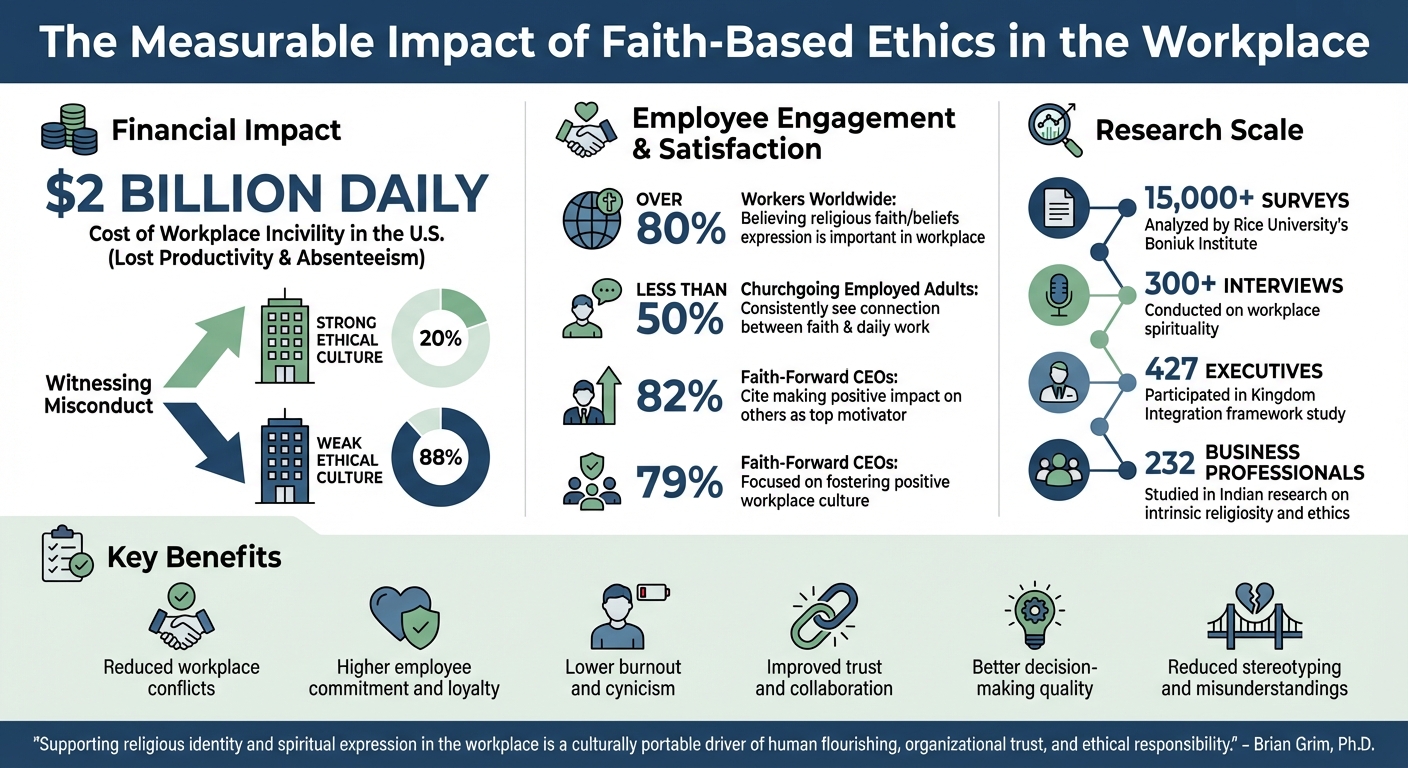
Faith-Based Ethics Impact on Workplace Performance and Trust
This study dives into how faith influences team dynamics, revealing its measurable effects on trust, decision-making, and organizational growth.
Better Team Trust and Collaboration
When teams incorporate faith-based ethics, trust becomes the bedrock of their interactions. Research highlights that workplace spirituality boosts both engagement and commitment, with trust acting as the key link between the two. A large-scale study by Rice University's Boniuk Institute, which analyzed over 15,000 surveys and 300 interviews, found that respecting and acknowledging religious identity is crucial for building trust and fostering social cohesion.
The costs of workplace incivility in the U.S. are staggering - around $2 billion daily due to lost productivity and absenteeism. Faith traditions that emphasize values like compassion, service, and integrity help create a sense of community and encourage collaboration. Employees who feel free to express their faith report lower levels of burnout and cynicism, even during challenging times like the COVID-19 pandemic.
"Supporting religious identity and spiritual expression in the workplace is not an isolated or tradition-specific practice, but a culturally portable driver of human flourishing, organizational trust, and ethical responsibility."
- Brian Grim, Ph.D., Religious Freedom & Business Foundation
Faith inclusion also minimizes intergroup conflict. Teams that embrace diverse religious identities experience higher trust, reduced stereotyping, and fewer misunderstandings rooted in cultural differences. Employees feel psychologically safer when they can bring their true selves to work, while suppressing religious identity often leads to feelings of alienation and disengagement.
This environment of trust lays the groundwork for deeper, more ethical decision-making.
Higher Quality Decisions
Faith-based ethics guide teams to make decisions that are thoughtful and grounded in values. Research shows that over 80% of workers worldwide, from various faith backgrounds, believe that expressing religious faith or beliefs is important in the workplace. However, fewer than half of churchgoing employed adults consistently see a connection between their faith and their daily work.
Frameworks like "Kingdom Integration" help teams address underlying issues rather than just surface-level problems, as demonstrated in a study involving 427 executives.
"Without a strong biblical worldview, decisions risk becoming catastrophic."
- Dr. Rick Hall, Director and Professor of Leadership and Management, Colorado Christian University
The shift from "law-based" or "outcome-based" ethics to "duty-based" and "virtue-based" ethics marks a significant difference. These approaches emphasize moral responsibility and character over short-term financial results. Additionally, research indicates that a "Balanced View" of faith - combining hope with accountability - encourages individuals to approach ethical dilemmas with greater care and moderation.
These decision-making processes not only enhance teamwork but also lead to measurable improvements across organizations.
Positive Impact on Organizations
The influence of faith-based ethics extends well beyond team dynamics and decision-making, transforming organizations at their core. Intrinsic religiosity - where faith is deeply internalized - has been linked to ethical awareness and the intent to act ethically. For example, a study of 232 Indian business professionals revealed that intrinsic religiosity strongly predicts the use of justice and duty-based ethics in decision-making.
The 2025 Ethisphere "World's Most Ethical Companies" list, which includes major corporations like AT&T, IBM, Dell, and PepsiCo, shows that high ethical standards can coexist with business success. Ministry Brands, supporting over 90,000 churches and nonprofits while managing billions in charitable giving, has built its culture around a faith-driven mission.
Faith-based ethics help break down silos and encourage collective problem-solving by aligning personal and professional values. They also shift the focus toward long-term impact, stewardship, and resilience, rather than chasing short-term goals. This approach fosters a purpose-driven culture where employees see their work as meaningful and impactful, far beyond just earning a paycheck.
Biblical Principles for Team Decisions
Drawing from a foundation of ethical decision-making, biblical principles provide a reliable guide for leading teams through challenging choices.
Core Principles: Integrity, Stewardship, and Servanthood
Scripture offers clear direction for navigating complex decisions. Integrity, highlighted in Proverbs 11:1, emphasizes fairness in all dealings - whether it's honest advertising, timely payments to suppliers, or honoring warranties. Within a team, this principle calls for leaders to align their actions with their words, fostering trust and credibility.
Stewardship reminds us that all resources are entrusted to us by God. The Parable of the Talents (Matthew 25:14-30) underscores the responsibility to manage time, finances, and talents wisely - not for personal gain but to serve others. This principle encourages teams to share their skills and resources for the greater good.
Servant leadership redefines leadership as service. Max DePree, former CEO of Herman Miller, captures this idea perfectly:
"The first responsibility of a leader is to define reality. The last is to say thank you. In between, the leader is a servant".
Servant-led teams focus on how they can serve their organization and honor God rather than seeking personal authority.
Using Compassion and Justice in Team Scenarios
Building on these principles, teams can apply compassion and justice to practical situations.
Justice and fairness, rooted in Colossians 4:1, emphasize providing what is "right and fair". This principle supports practices like fair wages, safe working environments, inclusive hiring processes, and non-discriminatory policies. When faced with ethical dilemmas, a commitment to justice ensures decisions are unbiased and equitable.
Compassion, or chesed in Hebrew, represents "committed love" and is expressed through kindness and respect. The Golden Rule from Luke 6:31 - "Do to others as you would have them do to you" - urges teams to consider the impact of their decisions on all stakeholders, particularly those who are most vulnerable. Dr. Letta Campbell, Program Director at Colorado Christian University, highlights this point:
"I think people just want to be treated like they matter and can have an impact. If you know people and you understand them, it allows you to take actions based on love".
The Micah 6:8 Model ties these principles together: Justice combined with Mercy builds trust through transparent integrity; Mercy paired with Humility fosters servant leadership with a mindset of generosity; and Humility alongside Justice cultivates a disciplined strength that remains teachable and avoids arrogance. A practical example of this model in action is the Jerusalem Council in Acts 15. The council addressed challenges by identifying issues, engaging in open discussion, relying on shared values, and seeking consensus that "seems good to the Holy Spirit and to us". These principles guide teams in making wise, thoughtful decisions that reflect care and integrity.
Practical Frameworks for Ethical Team Decision-Making
Values-Based Decision-Making Models
A structured approach can transform abstract ethical principles into actionable steps, as demonstrated by Ascension Health-Tennessee in 2020. Under the guidance of Director Emily Trancik, the organization utilized a Values-Based Decision-Making Guide to evaluate past decisions. This process involved an 8-question framework, which revealed they had initially overlooked key stakeholders. By including unit-level leadership in their review, they improved discussions about vulnerable populations and saw greater satisfaction among stakeholders.
The framework begins with a moment to "Pause and Pray", encouraging teams to seek divine guidance before making decisions under pressure. Next, teams identify the core dilemma, acknowledging competing priorities such as financial responsibility versus care for vulnerable groups. Gathering input from stakeholders is essential, followed by evaluating options against Scriptural teachings and principles like integrity and the Golden Rule. Finally, teams assess their internal state - peace rather than unrest often serves as a sign of spiritual alignment.
This model naturally guides teams toward seeking further wisdom through Scripture.
Using Scripture to Navigate Ethical Dilemmas
Scripture provides a comprehensive foundation for tackling ethical challenges. A prime example is the Jerusalem Council in Acts 15, which demonstrates how biblical principles can guide decision-making. Dr. Letta Campbell, Program Director and Professor of Human Resource Management at Colorado Christian University, explains:
"As a Christian businesswoman, I can tell you that a lot of the decisions that I make are based on what I feel God is moving me to do for His purpose and for His kingdom".
Teams should avoid relying on "selective verse application", where isolated verses are used to justify decisions. Instead, Scripture should be interpreted in light of God's character and Jesus' example. When facing ethical dilemmas, teams can use four guiding questions: How does this decision affect others? Is there a biblical precedent? Is it financially responsible? Does it consider diverse perspectives?. This approach fosters decisions rooted in both wisdom and compassion.
To ensure these principles are consistently applied, accountability measures are crucial.
Building Accountability and Reflection
Accountability is key to turning good intentions into lasting ethical practices. Teams should establish clear ethical codes rooted in Scriptural teachings, such as those found in Proverbs. Anonymous reporting systems for unethical behavior and incorporating ethics into performance reviews can reinforce these standards. Regular ethics training further helps employees align their work with biblical values.
Reflection strengthens a team's commitment to ethics. Reviewing past decisions can highlight missed opportunities to integrate faith. A "testing the spirit" approach - evaluating whether a decision brings peace or discomfort - can also help teams gauge alignment with their values. Studies show that ethical practices build trust within teams, and consistent reflection ensures these benefits endure. Dr. Rick Hall, Director and Professor of Leadership and Management at Colorado Christian University, underscores the importance of this process:
"The reality is none of us are perfect, and if we don't have the biblical worldview we're meant to have ... sometimes our decisions will be catastrophic".
Engaging spiritually mature mentors can provide valuable oversight and help identify blind spots. Creating safe spaces for team members to raise ethical concerns without fear of judgment fosters a culture where accountability feels natural and constructive.
Faith-Based Ethics in Action: Purpose-Driven Teams
Building a Culture of Integrity
When faith-based ethics take center stage, workplaces become environments where values guide every decision. Consider this: only 20% of employees report witnessing misconduct in companies with a "strong" ethical culture, compared to a staggering 88% in companies with weaker ethical foundations. This contrast highlights how a deliberate focus on ethics can prevent lapses in integrity.
Leaders play a key role in setting the tone. When leaders consistently align their faith with their actions - whether by pausing to pray before major decisions, owning up to mistakes, or keeping promises even when it's costly - they demonstrate that integrity is non-negotiable. Their actions speak louder than words, reinforcing a culture where ethics are lived, not just talked about.
Equally important is creating spaces where employees feel comfortable discussing ethical challenges. Open, judgment-free dialogue builds trust and encourages team members to voice concerns early, preventing small issues from escalating into larger problems. This transparency fosters an atmosphere where ethical behavior becomes second nature, laying the groundwork for faith-driven stewardship in business practices.
Aligning Business Practices with Faith Values
With integrity as the foundation, purpose-driven companies turn faith-inspired values into real-world actions. Take Brown Boot Coffee, for example. This company channels every purchase toward supporting nonprofit organizations, turning everyday transactions into opportunities to make a difference.
Their coffee blends, like Budaka Bold and Mayuge Morning, directly support Musana's mission, while others, such as Bootstrap Blend and Clyde's Roast, tell personal stories that connect customers to a greater purpose. By tying products to meaningful causes and individuals, Brown Boot Coffee transforms routine purchases into acts of community support.
This approach resonates with leaders as well. Research shows that 82% of "Faith-Forward" CEOs cite making a positive impact on others as their top motivator, while 79% focus on fostering a positive workplace culture. Employees who see their work contributing to meaningful outcomes report greater job satisfaction and stronger loyalty to their organizations.
Empowering Teams Through Shared Values
When a team's decisions are guided by shared values, trust and consistency naturally follow. Faith-driven values unite team members, creating a sense of purpose that goes beyond day-to-day tasks. Employees who see their personal beliefs aligning with their organization's mission often feel more motivated and less likely to consider leaving. But this alignment doesn’t happen by chance - it requires intentional efforts to respect and nurture the whole person, addressing their mind, body, and soul.
Leaders who let their faith shape their decisions inspire their teams to do the same. By openly sharing how their beliefs influence their actions, they encourage employees to bring their full selves to work, fostering a culture of mutual respect and shared purpose.
The benefits of this approach are measurable. Workplace incivility costs U.S. employers around $2 billion daily in lost productivity and absenteeism. Teams united by shared values not only avoid these pitfalls but also strive for excellence as an expression of their faith. They view their work as a form of worship, aiming to honor a higher purpose rather than focusing solely on profit.
Conclusion: The Power of Faith-Based Ethics
Faith-based ethics offer practical strategies that can lead to measurable benefits for teams and organizations. Research shows that workplaces with strong ethical cultures not only experience reduced misconduct but also save billions in lost productivity. For instance, workplace incivility alone costs U.S. employers about $2 billion each day. These numbers highlight the economic advantages of fostering an ethical workplace culture.
On a personal level, employees often find greater job satisfaction and commitment when their work aligns with their beliefs. Viewing work as a calling rather than just a job can lead to higher levels of satisfaction, stronger loyalty to the organization, and greater psychological resilience. As Brian Grim, Ph.D., President of the Religious Freedom & Business Foundation, explains:
"Supporting religious identity and spiritual expression in the workplace is not an isolated or tradition-specific practice, but a culturally portable driver of human flourishing, organizational trust, and ethical responsibility".
However, many regular churchgoers still struggle to connect their faith with their daily work, revealing an opportunity for organizations to bridge this gap. Mitch Neubert, Chavanne Chair of Christian Ethics in Business at Baylor University, refers to this as the "Sunday-Monday" divide. By integrating principles like integrity, stewardship, and compassion into decision-making, teams can foster trust and create environments where ethical behavior thrives.
The research points to the importance of intentionally weaving faith into everyday workplace decisions. Leaders play a crucial role in bridging the faith-work divide by modeling this integration and cultivating spaces where employees feel comfortable bringing their whole selves to work. This approach promotes respect, voluntariness, and dignity for everyone. When implemented effectively, faith-based ethics can form the foundation for teams that not only achieve financial success but also leave a meaningful impact on the world.
At Brown Boot Coffee, we strive to live out these principles by embedding faith-based values into our business practices. This commitment helps us build a community centered on ethical excellence and genuine care for our team and customers.
FAQs
How can faith-based ethics fit in a diverse workplace?
Faith-based ethics play a meaningful role in enriching workplace diversity by encouraging moral integrity and honoring employees' spiritual values. When approached thoughtfully, these principles can boost job satisfaction, build trust, and inspire motivation, ultimately helping to lower turnover rates. By focusing on shared values such as honesty and fairness, organizations can design policies that respect a variety of beliefs, encourage ethical decision-making, and nurture a positive and welcoming workplace culture.
What’s a simple steps-based model for ethical team decisions?
When making decisions as a team, a straightforward approach rooted in ethics and faith can be guided by asking four essential questions:
- How will this decision impact outcomes? Consider the potential consequences and whether they lead to positive or negative results.
- Does it align with core values and faith principles? Reflect on whether the choice stays true to shared beliefs and moral guidelines.
- What responsibilities and duties are involved? Identify the obligations at play and ensure they are fulfilled with integrity.
- How will it affect the community and relationships? Think about the broader impact on people and connections within the group and beyond.
By following these steps, teams can make decisions with purpose and a focus on faith-driven ethics.
How can leaders connect faith and work without pressure?
Leaders can seamlessly integrate faith and work by anchoring their decisions in fundamental spiritual and moral principles. This approach nurtures trust and integrity within their teams. Asking reflective questions like “Does this decision align with my core values?” can encourage genuine leadership. By cultivating self-awareness and prioritizing values like compassion and service, leaders can establish a workplace culture rooted in purpose and honesty - without feeling pressured or overwhelmed.