


10 Ways Coffee Purchases Can Support Nonprofits
Your daily coffee habit can do more than fuel your mornings - it can support causes that matter. Many coffee brands are turning profits into meaningful contributions, funding initiatives like poverty relief, education, health programs, environmental conservation, and more. Here's a quick look at how your coffee purchases can make a difference:
- Profit Donations: Companies like Generous Coffee and One Cup Coffee Co. donate a percentage of their profits to nonprofits, funding programs like clean water systems and health clinics.
- Fair Trade: Brands ensure farmers earn fair wages through partnerships, improving livelihoods and creating long-term benefits.
- Women's Empowerment: Programs like Café Femenino support women farmers with leadership training, healthcare, and financial independence.
- Environmental Efforts: Coffee companies contribute to reforestation, carbon offset projects, and sustainable farming practices.
- Health Initiatives: Brands like Sip of Hope and Grounds for Health fund mental health services, cancer screenings, and addiction recovery programs.
- Animal Welfare: Companies like Grounds & Hounds donate profits to animal rescue and care.
- Youth Development: Programs like Coffee Kids invest in education and career training for young people in coffee-growing regions.
- Subscription Donations: Coffee subscriptions often include recurring donations to nonprofits, providing steady funding.
- Limited Edition Roasts: Special roasts target specific causes like disaster relief or wildlife conservation.
Every cup of coffee you buy can support nonprofits tackling big challenges, from poverty to climate change. Choose brands that align with your values and turn your coffee habit into a force for good.
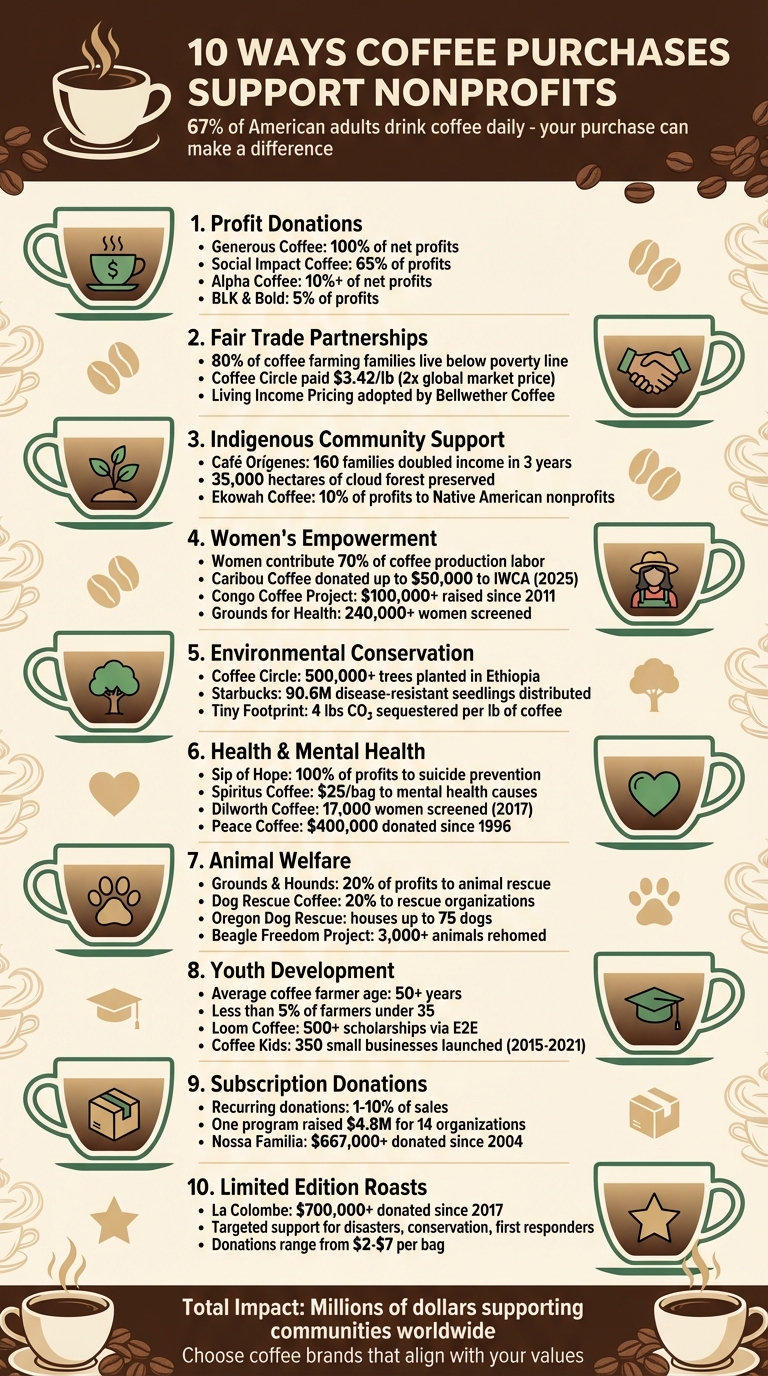
10 Ways Coffee Purchases Support Nonprofits: Impact Statistics
Heretic Coffee in Portland raises over $300,000 for free community breakfasts for SNAP recipients
sbb-itb-c3999cb
1. Coffee Companies That Donate Profits to Nonprofits
Some coffee companies have designed their businesses to do more than just sell coffee - they’ve made giving back a core part of their mission.
Take Generous Coffee, for example. This company operates as a "for-purpose" business, channeling 100% of its net profits toward nonprofits focused on improving lives. Every dollar of profit goes directly to charitable causes. Similarly, Social Impact Coffee, founded by Adrian Evans in the UK, is legally obligated to donate 65% of its profits to initiatives like the mental health charity Young Minds.
"This isn't a charity - it's a business committed to allocating 65% of profit to good causes." – Adrian Evans, Founder, Social Impact Coffee
Other coffee companies take different approaches to giving. Nossa Familia Coffee commits 1% of its annual gross profits to nonprofit organizations. Meanwhile, Alpha Coffee donates over 10% of its net profits to support veterans, environmental efforts, and community programs.
Percentage or Amount of Proceeds Donated
The way companies structure their donations varies widely. For instance, La Colombe uses a per-unit model for its "Lyon" blend, donating $2.00 from every box sold to groups like the ACLU. Between November 2022 and May 2024, this model helped raise $300,000, with a guaranteed minimum contribution of $50,000 during that timeframe. Peace Coffee takes a different route, donating 1% of all online purchase totals to nonprofits chosen by their customers. Then there’s BLK & Bold, which pledges 5% of its profits to support youth programs and combat homelessness.
Impact or Outcomes Achieved
By integrating charitable giving into their profit models, these companies are driving meaningful change. For example, Nossa Familia’s "Next Generation Coffee" program donates $1.00 per bag (split evenly between the company and its partner, New Seasons Market) to fund the Young Entrepreneur Fund in Guatemala. One Cup Coffee Co. takes a similar approach, dedicating at least 15% of its online sales to World Vision. These contributions are often amplified through matching grants, providing critical aid to children and families in Kenya and beyond.
These diverse models demonstrate how businesses can make a tangible difference while still thriving in a competitive market. By aligning profits with purpose, these coffee companies are proving that giving back can be part of a successful business strategy.
2. Fair Trade Partnerships That Support Farmer Income
Fair Trade partnerships play a crucial role in ensuring coffee farmers earn a livable income. Globally, 80% of coffee farming families live below the poverty line. While retail coffee prices have risen over the years, the base price paid to many farmers has remained largely stagnant for four decades.
Specific Nonprofit or Cause Supported
Some companies collaborate directly with nonprofits to create meaningful changes at the farm level. For example, Nossa Familia Coffee teamed up with the nonprofit De la Gente to support the Women Coffee Growers of UPC in Guatemala. Through this partnership, they funded the purchase of motor-operated depulpers. Previously, the community relied on manual depulpers, which could only process 100 pounds of coffee per hour. The new equipment reduced processing time to under five minutes, significantly improving efficiency and increasing the value of the farmers' labor.
Peace Coffee has taken a different route by supporting Food 4 Farmers, which runs "Solidarity Market" initiatives. In 2023, Alcides Hurtado, a member of the COMEPCAFE cooperative in Colombia, diversified his 22-acre farm by introducing crops like bananas, avocados, and citrus. This diversification added an average of $267 per month to his income beyond coffee sales, allowing him to cover household needs and reinvest in his farm.
These efforts pave the way for pricing models that can create long-term benefits for farmers.
Impact or Outcomes Achieved
Beyond these direct initiatives, Living Income Pricing has emerged as a game-changer in fair trade. Unlike traditional models that simply pay above market rates, this approach calculates prices based on what farmers need for a dignified livelihood. Bellwether Coffee adopted Living Income Pricing contracts in Colombia and Guatemala in December 2024, aiming for 100% of its coffee purchases to align with this framework by 2025.
"Paying a more equitable price for coffee is not just the ethical thing to do - it's key to the future of a thriving, sustainable, and diverse coffee industry" – Alex Bravo, Bellwether Coffee
Coffee Circle offers another example of how direct trade models can make a difference. In 2022, they paid an average of $3.42 per pound for green coffee - more than double the global market price. In 2021, their payments were 99.375% above the Fairtrade minimum price of $1.60 per pound. These payments funded washing stations and quality training for Ethiopian cooperatives like Buture (570 producers) and Bikila Ibsa (1,100 producers), helping them export specialty coffee and increase their income potential.
3. Programs Supporting Indigenous Communities and Land Protection
Indigenous coffee growers often face serious economic hurdles that can jeopardize their ability to stay on ancestral lands and safeguard critical ecosystems. By purchasing coffee that supports these communities, consumers contribute to economic independence while helping to protect these vital environments.
Specific Nonprofit or Cause Supported
In 2021, the Andean Alliance for Sustainable Development teamed up with Indigenous producers in the Peruvian Andes to create the Café Orígenes Cooperative. This initiative allowed over 160 families to double their income within three years while preserving 35,000 hectares of cloud forest through regenerative farming practices.
"When Indigenous farmers earn fair incomes, they can stay on their land, protect the forest, and preserve their cultural heritage." - Yungas Project
Ekowah Coffee, founded by Osage Nation member Joshua Smith, dedicates 10% of its profits to Native American nonprofits. By January 2026, beneficiaries included the Wahzhazhe Ballet and Dance Maker Academy, organizations that preserve Osage heritage through dance. Similarly, Spirit Mountain Roasting Company, owned by Quechan citizen Tudor Montague, received mentorship from Native FORGE in May 2024. This support helped him grow his business on the Fort Yuma-Quechan Reservation, hire five tribal members, and source coffee beans exclusively from Indigenous or women growers. This approach strengthens an Indigenous "seed to cup" supply chain. These efforts not only improve economic opportunities but also reinforce cultural traditions and promote environmental care.
Impact or Outcomes Achieved
These programs are making a difference. For example, Indigenous Arizonans own less than 1% of small businesses in the state, a disparity that initiatives like Native FORGE are working to address. Another example is Peace Coffee, which supports the ANEI Co-op in Colombia. Founded by Arhuaco leader Aurora Izquierdo, this cooperative uses coffee production to uphold the social, economic, and cultural rights of its members while promoting eco-friendly practices. Cooperative models like these empower Indigenous producers to sustain their cultural traditions while achieving economic stability.
4. Women's Empowerment Programs in Coffee Production
Women contribute to 70% of the labor in coffee production but often face challenges such as limited land ownership and earning less than their male counterparts. Supporting women in coffee farming not only promotes gender equality but also strengthens the communities vital to the specialty coffee industry. By purchasing coffee tied to women's empowerment programs, consumers help fund initiatives that focus on financial independence, healthcare, and leadership training in farming communities.
Specific Nonprofit or Cause Supported
Many coffee companies collaborate with organizations dedicated to advancing women's economic and social empowerment. For example, from March 6 to June 4, 2025, Caribou Coffee ran the "Amy's Blend 2025" campaign in partnership with the International Women's Coffee Alliance (IWCA). Through this initiative, Caribou Coffee donated $1 per bag sold (up to a total of $50,000) to IWCA chapters in Guatemala, Costa Rica, Ethiopia, and Kenya. These funds were used for training programs in sustainable agriculture, grafting techniques, and leadership development.
Equal Exchange has been running the Congo Coffee Project in collaboration with the Panzi Foundation since 2011. This project supports survivors of sexual violence in the Democratic Republic of Congo and has raised over $100,000. Specific allocations include $50,000 for vocational training, $11,000 for water system improvements at the Bulenga Clinic, and $40,792 for building and equipping a medical laboratory. Similarly, in August 2025, Hacea Coffee Source introduced its "HER Coffee" program with Grounds for Health, donating the cost of one cervical cancer screening kit for every bag sold.
The Café Femenino Foundation employs a direct-payment model where roasters contribute a portion of their coffee purchases to fund projects requested by the participating communities. This model ensures that women receive premiums directly and gain legal rights to their land as part of the program. These examples highlight how focused initiatives can drive both economic and social progress for women in coffee farming.
Impact or Outcomes Achieved
In 2017, Blue Bottle Coffee paid a premium of $1.12 per pound for coffee sourced from the Kinyovu Washing Station in Burundi as part of the IWCA premium payment program. This amounted to $13,185, which was distributed among over 1,000 women farmers. The funds allowed these farmers to invest in bicycles, motorcycles, and livestock, improving both their efficiency and income. That same year, the Burundi IWCA chapter earned a total premium of $80,000 from coffee sales.
"When women receive their Café Femenino premium, initially men would stare in disbelief because they're getting more money, but slowly they're getting used to it and understanding what Café Femenino is." - Luisa Marroquin Guarchaj, Former Coordinator, Guatemala Café Femenino Women's Group
Grounds for Health has made a significant impact by screening over 240,000 women and treating more than 20,000 for cervical pre-cancer in coffee-growing regions since 1996. In 2023, the Bellwether Coffee Farmer Impact Fund supported the ACODIHUE cooperative in Guatemala, where 70% of members are Indigenous women. This funding provided emergency dental care for 14 individuals, including 12 women. These programs have led to measurable improvements in women's health, financial independence, and leadership opportunities.
5. Environmental Conservation and Farming Practices
Coffee purchases don't just support communities - they can also play a role in protecting our planet. By choosing coffee from companies focused on conservation, you contribute to efforts like reforestation, soil regeneration, and carbon reduction, all of which help preserve ecosystems in coffee-growing regions. Here are some initiatives that show how coffee companies are making a difference.
Specific Nonprofit or Cause Supported
Tiny Footprint Coffee teamed up with the Mindo Cloudforest Foundation (MCF) in August 2021 to enhance forest connectivity within Ecuador's UNESCO-designated Choco Andino of Pichincha Biosphere Reserve. With a $40,000 commitment, the company supplied 30,000 trees, focusing on species listed on the IUCN Red List. For every pound of coffee sold, they sequester 4 pounds of CO₂.
Coffee Circle has planted over 500,000 trees in Ethiopia's Jimma region since its inception. Between 2022 and 2023, they partnered with Welthungerhilfe to plant 177,972 seedlings, including 55,000 coffee plants. Through tree nurseries set up in the Mana and Gomma districts, farmers received seedlings to improve coffee quality and increase carbon capture. Additionally, for every kilo of coffee sold, €1 is contributed to the Coffee Circle Foundation.
Stumptown Coffee Roasters offers a customer-driven approach by donating 1% of every order through the Beam platform. Customers can choose nonprofits like One Tree Planted, which focuses on reforestation efforts.
Gimme Coffee directs 3% of sales from its Rally Blends (starting at $22.50 per bag) to local nonprofits working on environmental projects.
Peace Coffee supports carbon and climate initiatives by donating 3 cents per pound of coffee sold. They also contribute 1% to 2% of online sales to organizations like Grow Ahead, which funds agroforestry projects. During Earth Month, this contribution doubles to 2%. These donations create measurable environmental benefits, as seen in the outcomes below.
Impact or Outcomes Achieved
Starbucks and Conservation International have distributed 90.6 million disease-resistant coffee seedlings to farmers in Mexico, El Salvador, and Guatemala as of 2022. This effort supports their 2025 goal of providing 100 million trees. These seedlings are designed to help farmers adapt to climate challenges without resorting to deforestation.
"All these seedlings offset 10 times more CO₂ than we create through the logistics of buying and roasting coffee." – Coffee Circle
Food 4 Farmers has planted nearly 38,000 trees in coffee-growing communities, helping families establish home gardens and beekeeping ventures. These agroforestry practices not only provide additional sources of nutrition and income but also create microclimates that shield coffee plants from extreme weather and drought, while boosting biodiversity. These efforts strengthen ecosystems and improve livelihoods for farmers.
6. Health and Mental Health Advocacy Programs
Did you know your daily coffee habit could help fund essential health and mental health services? Some coffee companies donate anywhere from 1% to 100% of their sales to organizations tackling issues like suicide prevention, addiction recovery, cervical cancer screening, and healthcare for survivors of violence. These contributions lead to real-world outcomes, such as therapy sessions and the construction of medical facilities. Let’s dive into how specific coffee brands are driving change through their partnerships and donations.
Specific Nonprofit or Cause Supported
Equal Exchange has been collaborating with the Panzi Foundation since 2011 through the Congo Coffee Project. This initiative supports survivors of sexual violence in the Democratic Republic of Congo. Over the years, the project has raised more than $100,000, including $50,000 for vocational training, $23,000 for building a medical laboratory at the Bulenga Clinic, and $17,792 in 2019 for lab equipment and technician training.
Spiritus Coffee Co. takes it a step further by donating every penny of its sales - 100% of proceeds - to nonprofits focused on mental health and substance abuse recovery, with $25.00 per bag going directly to these causes. Similarly, Sip of Hope Coffee has made history as the first coffee brand to allocate 100% of its profits to suicide prevention and mental health education.
Dilworth Coffee supports cervical cancer screening in coffee-growing communities through its "Grounds for Health Blend." For every 12oz bag sold, $1 is donated, while $5 is contributed for every 5lb bag. In 2017, these efforts helped screen 17,000 women and provided treatment for over 2,000 diagnosed with cervical cancer. Meanwhile, Gimme Coffee donates 3% of all sales from its Rally Blends series to organizations like Sister Song and the New York Abortion Access Fund, which focus on reproductive health and justice.
Peace Coffee gives customers the option to direct 1% of their online purchases to nonprofits, including those that support LGBTQ+ Mental Health. Since its founding in 1996, the company has contributed nearly $400,000 to community organizations. Happy Products (happy® coffee) has taken a bold approach by giving the National Alliance on Mental Illness (NAMI) an ownership stake in the company. They’ve also integrated a QR code on every product that connects consumers to the NAMI HelpLine. Beyond that, they’ve established a wellness group for female coffee farmers in Colombia, offering access to social workers and mental health resources.
These efforts highlight how coffee brands can turn consumer purchases into meaningful support for health initiatives, creating measurable benefits for communities.
Impact or Outcomes Achieved
In November 2020, the nonprofit GoFundBean partnered with Oatly to launch the "Stay Grounded" initiative. This program provided 16 hourly coffee workers with a three-month subscription to Talkspace, a virtual therapy platform. The subscription included unlimited messaging and one live video session per month. Notably, 50% of the program’s spots were reserved for Black, Indigenous, and POC workers to address disparities in mental health access.
Convict Coffee Company also made a difference through its "Quarter for a Quarter" program, which donates 25¢ from every drink sold during specific quarterly campaigns. In Q2 2025, the program raised $7,784 for the Juvenile Assessment Center (JAC), funding early intervention and mental health resources for youth and families. Between Q3 2024 and Q3 2025, the company raised over $8,800 for Step Seven Ministries, which supports recovery programs for justice-involved individuals. This initiative contributed to a reported 7% recidivism rate among participants.
"At Panzi, our holistic care program…shows that even if the road to recovery is long and difficult, victims have the potential to turn their suffering into power." - Dr. Denis Mukwege, Founder, Panzi Hospital
These examples show how coffee companies are stepping up to address critical health and mental health challenges, proving that even small purchases can have a big impact.
7. Animal Welfare and Rescue Programs
Coffee purchases don’t just fuel your mornings - they also play a role in supporting animal rescue and care efforts.
Many coffee companies dedicate a portion of their profits - ranging from 20% to 25% - to animal welfare organizations. These funds help sustain initiatives like no-kill shelters, spay/neuter programs, and even international rescue missions.
Specific Nonprofit or Cause Supported
Grounds & Hounds Coffee Co. channels 20% of its profits to animal rescue organizations. Its "Rescue Roast" blend goes a step further, donating 100% of profits to featured partners. For example, in February 2026, it supported The Animal Pad, an organization rescuing dogs from high-kill shelters and the streets of Mexico.
Dog Rescue Coffee Company contributes 20% of its profits to groups like Puppy Rescue Mission, which has rescued over 3,500 animals in 50 countries. This organization also reunites these animals with U.S. soldiers who cared for them during deployments.
Off Hours Coffee Project donates 25% of its profits to the San Francisco SPCA. Similarly, Barkhouse Coffee gives $1 from every bag sold to the PAWS Shelter of Central Texas. Hugo Coffee Roasters supports Nuzzles & Co's Rez Rescue program, which provides vital veterinary services - like vaccinations and spay/neuter surgeries - and operates a pet food pantry for nearly 3,000 people on the Ute Reservation in Utah, where veterinary care is scarce.
These efforts provide critical support to animals and their caregivers, often in underserved areas.
Impact or Outcomes Achieved
The impact of these programs is evident in the lives they touch. For instance, Oregon Dog Rescue, a no-kill shelter funded in part by coffee sales, can house up to 75 dogs at any given time. Hugo Coffee Roasters' Purple Paw Program has helped over 190 pets find permanent homes and supported 191 family pets for survivors of domestic violence. It also raises awareness through weekly "Adoptable Moment" radio features.
"The world was not in dire need of another coffee brand at the time, but the world was in need of a company that served to make a difference for rescue pups."
- Jordan Karcher, Founder and CEO, Grounds & Hounds Coffee Co.
The Beagle Freedom Project, another partner organization, has rehomed over 3,000 animals across 15 countries. It has also successfully lobbied for laws requiring laboratory animals to be adopted rather than euthanized. These initiatives continue to expand rescue services and provide essential care for animals in need.
8. Youth Development and Education Programs
When you buy coffee, you’re doing more than just enjoying a cup - you’re helping fund education and career training for young people in coffee-growing regions. With the average coffee farmer now over 50 years old and less than 5% under 35, these programs are tackling an urgent challenge: preparing the next generation to build meaningful careers in coffee farming.
Specific Nonprofit or Cause Supported
Loom Coffee has teamed up with Educate 2 Envision (E2E), donating a share of profits from their Honduras coffee offerings, like Santa Lucia Reserve Organic. These contributions have helped establish 11 secondary schools and provided over 500 scholarships to youth in rural coffee-producing areas of Honduras as of February 2026.
In Costa Rica, Cafe Imports introduced the Café Juventud (Youth Coffee) program in August 2024 in collaboration with the Coopelibertad cooperative. They contribute a $0.10 per pound premium on coffee lots from 70 producers under 35. The funds support workshops on sustainable farming, barista training, and business management.
Meanwhile, Chica Bean offers Madre Chica Coffee, a special brand developed by 6th-grade girls at Miguel Magone Home in Guatemala. Through a 10-month internship, these students gain hands-on experience in coffee science, roasting, and logistics. Proceeds from sales go directly toward their education and mentorship opportunities.
In Nashville, Humphreys Street, led by head roaster Ruben Torres, provides job training and mentorship to underserved high school students. Impressively, 100% of the program’s profits are reinvested into scholarships and initiatives for its student workers, who also benefit from financial literacy classes and college tours.
These efforts are already shaping brighter futures for young people and opening up new career possibilities.
Impact or Outcomes Achieved
From 2015 to 2021, the Coffee Kids program, run by Hanns R. Neumann Stiftung, used $75,000 in seed funding to help young entrepreneurs in Guatemala, Honduras, and Tanzania launch around 350 small businesses. For instance, Alejandro Herrera Cruz from Guatemala turned his training into a thriving venture, creating products like coffee pulp soda and coffee beer while exporting his own roasted coffee.
"Economic viability is essential for coffee production to be a legitimate career path. For there to be a future workforce in coffee production our youth must be able to generate a living income and experience economic stability." - International Coffee Organization
These programs go beyond agricultural skills, teaching life lessons like leadership, critical thinking, and self-confidence. Whether participants remain in coffee farming or explore other paths, they’re equipped to succeed. Every cup of coffee you enjoy helps pave the way for a sustainable future in the coffee industry.
9. Subscription Programs That Include Charitable Donations
Imagine enjoying your morning coffee while knowing that every sip contributes to a good cause. Many coffee subscription services make this possible by including built-in donations to nonprofits. These programs typically donate between 1% and 10% of sales - or a fixed amount like $0.50 to $1.00 per bag - to support charitable causes. With every delivery, these recurring donations help create lasting support for communities in need.
Percentage or Amount of Proceeds Donated
Different coffee subscription programs have their own spin on giving back. For example, one service donates 10% of every online order and bag sold to a rotating list of community partners, raising over $4.8 million for 14 organizations so far. Another program sets aside 3% of sales as unrestricted funds for local nonprofits and grassroots initiatives. Some services allow subscribers to choose which nonprofit receives 1% of their purchase at checkout, doubling that donation to 2% during Earth Month - this approach has resulted in nearly $400,000 donated to community organizations. Meanwhile, another program donates 1% of its annual gross profits to charitable causes and contributes 50¢ per bag for selected "Giveback Coffees", amassing over $667,000 in cash and in-kind contributions since 2004.
Specific Nonprofit or Cause Supported
These programs take a broad approach to making a difference by supporting a variety of causes. Some focus on local nonprofits and grassroots efforts, while others allow subscribers to direct their donations to the causes they care about most. The supported initiatives range from youth development and community-building projects to environmental conservation efforts.
Impact or Outcomes Achieved
The impact of these programs goes beyond the donation amounts. By pairing the convenience of subscriptions with regular contributions, they create a steady funding source for nonprofits. This predictable income helps organizations address immediate needs and plan for long-term goals. Some programs have even provided half a million cups of coffee to those in need. Others sweeten the deal with perks like a 20% discount on subscriptions, making it easier for customers to give back while enjoying their coffee. The recurring nature of these donations ensures that nonprofits can count on a reliable stream of support to fulfill their missions effectively.
10. Limited Edition Roasts That Support Specific Causes
Limited edition roasts take charitable contributions to a more targeted level, addressing specific social and environmental challenges. These roasts are created through partnerships between coffee roasters and organizations, focusing on causes like clean water initiatives, reforestation projects, or support for first responders.
Percentage or Amount of Proceeds Donated
The way donations are structured varies widely. Some programs allocate a fixed amount per bag sold, such as $7 from a $15.00 bag or $2 per bag to protect marine ecosystems. Others donate a percentage of sales, like 10% of profits going toward wildlife conservation or nonprofit organizations. These flexible models allow roasters to align their giving with their mission and values.
Specific Nonprofit or Cause Supported
These roasts support a diverse range of causes. Some focus on environmental efforts like ocean and wildlife conservation, while others address social needs, such as mental health resources for first responders or assistance for military personnel overseas. For instance, one program contributed $250 for military care packages, while another raised over $9,000 to aid Hurricane Eta relief efforts.
Impact or Outcomes Achieved
The impact of these initiatives goes beyond the immediate financial contributions. Limited edition roasts not only provide funds for urgent needs but also raise awareness about critical issues and support long-term solutions. For example, they’ve helped deliver humanitarian aid during natural disasters, funded the construction of medical labs, and installed clean water systems in coffee-growing regions. By combining awareness with action, these roasts show how every purchase can make a meaningful difference in supporting nonprofit efforts.
Conclusion
Your daily coffee habit has the potential to spark meaningful social change. With 67% of American adults drinking coffee every day, the combined purchasing power of coffee drinkers creates a massive opportunity to back causes you care about. Whether your passion lies in clean water initiatives, youth education, conservation efforts, or human rights advocacy, there’s a coffee brand out there that aligns with your values.
Take a look at the numbers: La Colombe has contributed over $700,000 since 2017, Peace Coffee has given nearly $400,000, and One Cup Coffee Co. dedicates at least 15% of its online sales to humanitarian aid. These are powerful examples of how everyday purchases can make a real difference.
"By helping people think slightly differently about something they consume every day, we believe we can do a lot of good together." - Sur Coffee
Making an impact is easier than you might think. Look for brands that support nonprofits through Fair Trade Certified™ labels, B Corp certifications, or special "cause blends". Some retailers even allow you to choose which nonprofit benefits from your purchase at checkout.
It’s worth noting that 80% of coffee farming families worldwide live below the poverty line. By choosing coffee that supports fair trade, environmental programs, or direct-to-farmer initiatives, you’re helping to address this inequality. Every bag of coffee you buy becomes a small but important step toward a world where your morning ritual fuels positive change for both people and the planet.
FAQs
How can I verify a coffee brand’s donation claims?
To check if a coffee brand’s donation claims hold up, focus on clear communication and proof of their contributions. Trustworthy brands typically provide specifics about their nonprofit partnerships, the percentage of profits donated, or the causes they support. Look for third-party certifications, such as Fair Trade, which demand accountability. If the brand doesn’t offer detailed or verifiable information, it’s wise to remain skeptical. Brands that openly share their practices and have credible certifications are more likely to follow through on their promises.
What labels matter most for ethical coffee?
Certifications such as Fair Trade, Rainforest Alliance, Organic, and B Corp are among the most important labels to consider when choosing ethical coffee. These labels signify that the coffee was produced with care for fair wages, responsible farming practices, and environmental stewardship. By opting for coffee with these certifications, you can make more thoughtful choices that support both people and the planet.
Do subscriptions or one-time buys have a bigger impact?
Subscriptions offer nonprofits a dependable, ongoing source of funding, creating a lasting impact over time. On the other hand, one-time purchases provide immediate support, though their effects are often more short-term. Both approaches play a role in driving positive change, but subscriptions help sustain nonprofit efforts over the long haul.