


Best Coffee Beans for French Press Brewing
The French press brewing method brings out the natural oils and flavors in coffee, delivering a bold, rich, and textured cup. To make the most of it, focus on these key factors:
- Roast Level: Medium roasts offer balanced flavors like chocolate and caramel, while dark roasts provide intense, bold notes like molasses and dark chocolate.
- Coffee Origin: South/Central American beans are nutty and smooth, African beans are fruity and floral, and Indonesian beans are earthy with low acidity.
- Grind Size: Use a coarse grind (like sea salt) to avoid over-extraction and clogging the filter.
- Freshness: Choose beans roasted within 1–3 weeks for the best flavor.
Top Picks: Brown Boot Coffee offers excellent options like the hazelnut-rich Bootstrap Blend (medium roast), bold Budaka Bold (dark roast), and sweet Clyde's Roast (light roast). Prices range from $20–$25, and each purchase supports nonprofits.
For a smooth French press experience, pair high-quality beans with proper brewing techniques: steep for 4 minutes, use water at 195°F–205°F, and decant immediately after plunging. Whether you prefer single-origin beans for unique flavors or blends for consistency, the French press highlights every nuance in your coffee.
FRENCH PRESS: 5 Lessons I Learned the Hard Way
sbb-itb-c3999cb
How Roast Level Affects French Press Coffee
The roast level of your coffee beans plays a big role in shaping the flavor of your French press brew. Roasting alters the bean's density, oil content, and structure, which all influence how flavors are extracted during the typical four-minute steep. Medium to dark roasts tend to produce richer, more robust cups, while light roasts can sometimes result in a thinner or overly acidic taste.
One important aspect to consider is the extraction rate. Dark roasts, with their lower density and brittle texture, release flavors more quickly. On the other hand, light roasts demand more precision during brewing to achieve the full-bodied profile many French press fans love. The French press filter also allows natural oils to pass through, enhancing the body and texture of the coffee. Interestingly, over 60% of coffee drinkers choose the French press for its rich and flavorful results. Let’s dive into how medium and dark roasts perform specifically in this brewing method.
Medium Roasts: Balanced Flavor
Medium roasts are often seen as the "sweet spot" for French press brewing. They provide a harmonious mix of rich flavors, natural sweetness, and moderate acidity, steering clear of bitterness or overly dominant origin notes. When brewed in a French press, medium roasts can showcase delightful flavors like milk chocolate, caramel, honey, and nuts. As Twisted Goat Coffee puts it:
Medium roast in French press gives you clean, clear flavors without any roughness.
For optimal results, steep medium roasts for about four minutes at a temperature of around 200°F (93°C), just off the boil. Use a coarse grind similar to sea salt, and decant the coffee immediately after plunging to prevent over-extraction. Beans grown in high-altitude regions like Ethiopia, Colombia, and Kenya are particularly well-suited for this roast level, offering a clean flavor profile with reduced acidity. Now, let’s explore the bold characteristics of dark roasts.
Dark Roasts: Bold and Intense
Dark roasts deliver a bold and intense flavor experience when brewed in a French press. The extended roasting process brings oils to the surface of the beans, intensifies flavors like dark chocolate, nuts, and molasses, and reduces natural acidity. The lower density of dark roast beans also speeds up flavor extraction, resulting in a robust cup. Idalmis Holmes, Co-owner of Coffee Break Lovers, explains:
As a general rule, dark roast beans are best for the French Press. The reason is that dark roasts are oilier and easier to extract than lighter roasts.
To avoid bitterness with dark roasts, use slightly cooler water - around 195°F - and consider a shorter steep time of three to four minutes. Additionally, choosing low-acid beans from regions like Brazil, Sumatra, or India can help emphasize the earthy, chocolatey notes that dark roast lovers crave.
Coffee Origins and Flavor Profiles
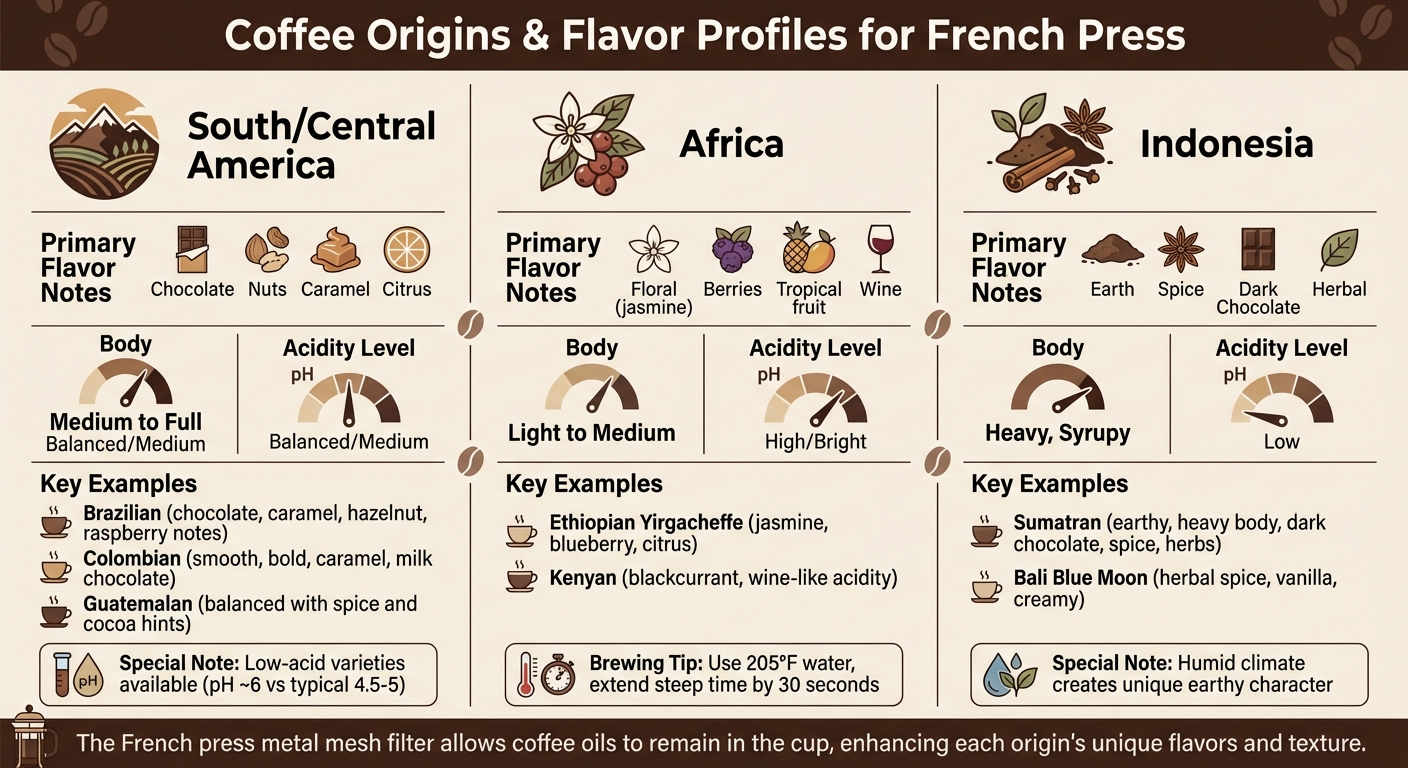
Coffee Bean Origins Flavor Profile Comparison for French Press
Where coffee beans are grown plays a major role in shaping the flavor of your French press brew. Factors like climate, altitude, soil, and processing methods all influence the final taste. Understanding these regional differences can help you pick beans that suit your preferences. The French press, with its metal mesh filter, allows coffee oils to remain in the cup, letting the beans' unique flavors shine through. As Mark Morphew, Founder of Bean Ground, explains:
The French press is an immersion brew method... everything stays in the cup. That includes the oils from the coffee bean. And those oils carry flavor and texture.
This is particularly noticeable with beans grown at high altitudes, like those from Central America and East Africa. These beans tend to be denser and have concentrated flavors, which work wonderfully with the French press's standard four-minute brewing process.
South and Central American Beans
Beans from South and Central America are known for their clean, balanced profiles, making them a great match for French press brewing. They often feature notes of chocolate, nuts, and caramel. These flavors, combined with a medium-to-full body, complement the immersion brewing method beautifully.
Take Brazilian beans, for example. Known for their heavy body and low acidity, they offer flavors like chocolate, caramel, hazelnut, and even hints of raspberry. Colombian beans, on the other hand, deliver a smooth, bold profile with caramel and milk chocolate notes. Both types work well with added milk or cream, which enhances their chocolatey tones.
For those with sensitive stomachs, beans from this region can be a gentler choice. While most coffee has a pH between 4.5 and 5, certain low-acid varieties - like Nicaraguan beans - can have a pH closer to 6. Guatemalan beans also stand out, offering a balanced flavor with subtle hints of spice and cocoa.
African Beans
African coffee beans are celebrated for their bright, fruity, and floral flavors, often accompanied by a wine-like acidity. Though they tend to have a lighter body, the French press method adds depth to their delicate flavors without overpowering their unique characteristics.
Ethiopian Yirgacheffe is a standout example. Grown on wild "heirloom" coffee trees, Yirgacheffe beans offer floral jasmine, blueberry, and citrus notes that gain extra texture through immersion brewing. Kenyan beans, meanwhile, are known for their blackcurrant flavors and pronounced, wine-like acidity.
To get the best results from African beans, try using slightly hotter water - around 205°F - and extending the steeping time by 30 seconds. This helps balance their high acidity with a fuller extraction.
Indonesian Beans
Indonesian beans are perfect for French press brewing, delivering a bold, heavy-bodied cup with minimal acidity. These beans are known for their syrupy texture and earthy, spicy, and herbal flavors. The region's humid climate and unique processing methods contribute to these distinct characteristics.
Sumatran coffee is a prime example. As Julia Bobak, Coffee Specialist, explains:
Sumatran coffee has a unique earthy character and a heavy body, directly resulting from the region's humid climate.
These beans often feature flavors of dark chocolate, spice, and herbs, along with very low acidity. Another example is Bali Blue Moon beans, which offer herbal spice, vanilla, and a smooth, creamy mouthfeel. Indonesian beans are often blended with lighter, more acidic varieties to add richness and body.
| Region | Primary Flavor Notes | Body | Acidity Level |
|---|---|---|---|
| South/Central America | Chocolate, nuts, caramel, citrus | Medium to Full | Balanced/Medium |
| Africa | Floral (jasmine), berries, tropical fruit, wine | Light to Medium | High/Bright |
| Indonesia | Earth, spice, dark chocolate, herbal | Heavy, Syrupy | Low |
Freshness and Grind Size for French Press
When it comes to brewing with a French press, the freshness of your beans and the grind size are just as important as the roast level and origin in determining the flavor of your coffee.
Because the French press uses an immersion method with a metal mesh filter, it fully showcases the quality of your beans - for better or worse. If your coffee beans are stale, there’s no hiding it. As Happily Coffee points out:
"French press doesn't hide anything. If the coffee is stale, you'll taste it."
Freshly roasted beans, when ground just before brewing, release natural oils that enhance the flavor, resulting in a vibrant and sweet cup. On the other hand, stale beans lead to a flat, lackluster brew. You’ll know your beans are fresh when they "bloom" as hot water is poured over them, releasing aromas and signaling peak flavor.
To ensure freshness, use your beans within 1–3 weeks of roasting. Always look for the roast date on the bag - it’s a much better indicator of freshness than a generic "best by" date. As James Roche, Co-Founder & Coffee Roaster at Wrexham Bean Co., emphasizes:
"Roast date is your only honest freshness anchor. 'Best by' dates are vague, but the roast date is a real timestamp."
The grind size is equally critical for a perfect French press brew. A coarse grind, similar in texture to sea salt or kosher salt, is ideal. This allows the coffee to extract evenly during the 4 to 6 minutes of immersion. If the grind is too fine, you risk over-extraction, which can result in a bitter and muddy cup, and it may clog the mesh filter. Conversely, a grind that’s too coarse can lead to under-extraction, leaving you with a weak, watery brew.
For consistent results, a burr grinder is your best bet. Unlike blade grinders, which create uneven particles and fine grinds that can slip through the filter, burr grinders produce a uniform texture. Always grind your beans right before brewing to preserve the delicate aromatics. Store your beans in their original one-way valve bag or an airtight container, keeping them in a cool, dark place. If you need to freeze them, portion the beans first and ensure they’re sealed tightly.
Blends vs. Single-Origin Beans
When brewing with a French press, you’ll need to decide between blends and single-origin beans, each offering its own flavor experience.
Blends combine beans from different regions to create a well-rounded flavor. As Spiritus Coffee Co. puts it:
Blends are often designed for balance and approachability. They tend to be consistent batch to batch.
This consistency makes blends a dependable go-to for your daily coffee needs.
On the other hand, single-origin beans come from a specific region, estate, or even a single farm. These beans highlight the unique characteristics of their origin - things like altitude, soil, and climate. Press Coffee Roasters explains:
Single origin coffee allows you to taste the unique flavor profile of the coffee beans from a particular origin, and can showcase the nuances of that specific terroir, altitude, and soil conditions.
Single-origin beans often deliver bold and distinct tastes, from the floral notes of Ethiopian Yirgacheffe to the earthy richness of Sumatran Mandheling.
The choice between blends and single-origin beans also plays into how their flavors interact with the French press brewing method. Blends tend to emphasize the full-bodied, balanced profile they’re crafted for, while single-origin beans bring out the vivid, region-specific flavors tied to their terroir.
Price can also influence your decision. Single-origin beans typically cost between $24.00 and $36.00 per bag, while blends are a more budget-friendly option, ranging from $16.00 to $19.00. If you enjoy adding milk or sweeteners, blends offer the robustness to hold up against those additions. But for black coffee drinkers seeking a more pronounced and unique flavor experience, single-origin beans are the way to go.
Best Coffee Beans for French Press Brewing
Looking for the perfect coffee beans for your French press? Brown Boot Coffee offers a fantastic selection priced between $20 and $25 per bag, with the added bonus of supporting nonprofits with each purchase. Whether you prefer medium, dark, or light roasts, there’s something to match your taste and brewing style.
Medium Roasts
Medium roasts are known for their balanced flavor, and Bootstrap Blend is a standout choice. This blend combines Ethiopian and Colombian beans to create a distinctive hazelnut profile. As Brown Boot Coffee puts it, "Hazelnut steadies your resolve". For the best results, use a coarse grind, a 1:15 coffee-to-water ratio, and steep for 4–9 minutes.
Another excellent option is Mayuge Morning, which offers a smooth, naturally sweet profile. The French press brewing method, especially with longer steep times, enhances its natural sugars, making it a delightful cup for any time of day.
Dark Roasts
If bold, robust flavors are your thing, dark roasts are the way to go. Bison Blend features Mexican beans that have been washed to highlight warm notes of baking spice and molasses. Thanks to the French press’s metal mesh filter, the oils from the beans remain in your brew, creating a rich, chewy texture. Steep for 3–4 minutes with water heated to 195°F–205°F for the best extraction.
For an even more intense cup, try Budaka Bold. This dark roast delivers bold, smoky, and chocolatey flavors with a full-bodied finish. To avoid over-extraction, pour your coffee immediately after plunging.
Light Roasts
For those who enjoy a brighter, sweeter cup, Clyde's Roast is an excellent choice. This light roast offers a sweet and tangy flavor profile that shines with the full-immersion method of the French press. Use a medium-coarse grind and steep for 5–6 minutes, maintaining water temperature between 195°F and 205°F to preserve its delicate notes.
No matter your preference, these blends are sure to elevate your French press experience.
Key Takeaways
To brew an exceptional French press coffee, a few essential factors come into play. Start with medium to medium-dark roasted beans for a balanced flavor, rich body, and lower acidity. The grind should be coarse, resembling sea salt, to avoid over-extraction and clogging the filter. For water temperature, aim for 195°F to 205°F, and let the coffee steep for 4 minutes for the best results.
Freshness is also key - use beans roasted within 1 to 3 weeks to capture their full flavor potential. The French press brewing method highlights every subtle note, so quality beans make all the difference.
For example, Brown Boot Coffee offers blends that perfectly suit this brewing style. Their specialty-grade beans, priced between $20 and $25, include options like the hazelnut-rich Bootstrap Blend, the bold and intense Budaka Bold, and the sweet, tangy Clyde's Roast. Plus, every purchase supports nonprofit organizations at no additional cost. With Brown Boot Coffee, you're not just enjoying a flavorful cup - you’re contributing to a greater cause with every bag you buy.
FAQs
Why is French press coffee sometimes gritty?
French press coffee often feels gritty because tiny coffee grounds can slip through the metal mesh filter, leaving some sediment in your cup. This happens because coffee grounds don’t dissolve in water, and the filter can’t catch every small particle. To minimize this, use coarser coffee grounds and pour slowly, leaving the sediment at the bottom of the press.
How do I keep French press coffee from turning bitter?
To keep your French press coffee smooth and balanced, start with a coarse grind size. This helps avoid over-extraction and keeps coffee grounds from sneaking through the filter. Stick to a brewing time of 3 to 4 minutes - going longer can result in unwanted bitterness. Also, make sure your water is heated to 195°F to 205°F. Temperatures above this range can pull out bitter compounds, so staying within this sweet spot is key for a better-tasting cup.
Should I use filtered water for French press?
Absolutely, using filtered water is a smart choice for French press coffee. It not only enhances the coffee's flavor but also helps achieve optimal extraction. Ideally, the water should have a balanced mineral content - somewhere between 50 to 100 ppm. This balance ensures the water interacts perfectly with the coffee grounds, bringing out the best flavors.
In short, filtered water can make a noticeable difference in the quality of your brew.