


Ultimate Guide to Zero-Waste Coffee Roasting
Zero-waste coffee roasting reduces waste and emissions at every stage, from sourcing beans to packaging. Here's what you need to know:
- Coffee's Carbon Footprint: Roasting and packaging make up about 15% of the coffee industry's emissions. Traditional roasting emits 1.2 pounds of carbon per cycle, while coffee chaff in landfills releases methane, which is 80x more harmful than CO2 over 20 years.
- New Technology: Electric and heat-recirculating roasters can cut emissions by up to 90%. Brands like Bellwether and Loring are leading this shift.
- Sustainable Sourcing: Ethical certifications, like Fair Trade and Organic, ensure beans are grown responsibly, supporting ecosystems and farming communities.
- Byproduct Reuse: Coffee chaff and grounds can be composted, used in gardens, or repurposed for innovative uses like car parts.
- Eco-Friendly Packaging: Options like compostable bags or mono-material recyclable packaging reduce waste while maintaining coffee freshness.
Every step, from sourcing to shipping, impacts the planet. Zero-waste roasting isn't just about reducing impact - it's about creating a better future for coffee and the people behind it.
Solar Coffee Roasting: A Weird Desert Experiment
sbb-itb-c3999cb
Sourcing Coffee Beans Responsibly
Zero-waste coffee roasting starts with thoughtful bean sourcing. This approach tackles waste at its roots - both environmentally and socially. Farms that use natural methods like composting, crop rotation, and ecosystem protection help prevent chemical runoff, reducing waste long before the beans reach the roaster. On the flip side, synthetic pesticides and fertilizers pollute soil and water systems, creating long-term environmental harm that extends well beyond the fields.
Over 60% of American millennials and Gen Z consumers value sustainability when choosing their coffee. And with climate change threatening to reduce up to 50% of coffee-growing land by 2050, the decisions made today will determine the future of coffee production - and whether quality beans remain available.
Ethical Certifications Explained
Certifications provide a reliable way to assess whether coffee beans align with zero-waste principles. For example:
- Fair Trade guarantees farmers receive a minimum price, along with a "Fair Trade Premium" for community projects like sustainable farming infrastructure.
- Organic certification ensures at least 95% of USDA Organic coffee is grown without synthetic chemicals, encouraging natural composting and crop rotation to protect ecosystems.
- Rainforest Alliance (recognized by the "Green Frog" logo) focuses on responsible water and waste management, though only 30% of a coffee lot must meet these criteria to earn the seal.
- Bird Friendly certification from the Smithsonian sets a high bar, requiring 100% organic farming and diverse forest canopies that naturally manage pests and fertilization.
- Carbon Neutral certifications tackle greenhouse gas emissions by requiring farms to measure, cut, and offset carbon through energy-efficient practices and reforestation.
"Certifications are more than just stickers on a bag. They are tools that connect consumer expectations with farm practices, while also shaping the economics of coffee supply chains." - ICT Coffee
It’s important to note that simply buying certified beans doesn’t mean you can display the certification logo on your packaging. Each step of the supply chain must typically be certified to ensure accountability. This chain of custody ensures that ethical sourcing translates into sustainable practices all the way to the roaster.
Partnering with Purpose-Driven Brands
Collaborating with mission-focused coffee brands is another way to ensure sustainable sourcing. These brands often pay prices that reflect actual production costs, enabling farmers to invest in waste-reducing measures like composting systems and water conservation technology. Instead of relying on unpredictable commodity market rates, they focus on transparent pricing models like "farmgate" or "FOB" (Free On Board) prices.
Take Brown Boot Coffee, for instance. This company blends specialty coffee with a mission-driven approach, supporting nonprofits with every purchase - at no additional cost to customers. Their roasts, like Budaka Bold and Mayuge Morning, directly fund Musana's initiatives in Uganda, empowering farming communities to adopt sustainable practices. By choosing blends like Bootstrap Blend, you’re supporting supply chains that prioritize both quality and ethical sourcing.
"By conducting business in the coffee sector in that way, we can confront inequality and cultivate humanity's vast potential." - Jennifer Yeatts, Director of Coffee, Higher Grounds Trading Co.
Transparency is key. Purpose-driven brands often share detailed sourcing information, including how much of each dollar goes back to farming communities. This level of openness builds trust and helps justify higher prices for consumers who care about supporting regenerative agriculture and reducing waste. More than 70% of coffee drinkers under 35 actively seek brands that protect both people and the planet, making ethical sourcing not just a moral choice, but also a smart business move.
These sourcing practices lay the groundwork for eco-friendly roasting methods that further cut down on waste.
Eco-Friendly Roasting Methods
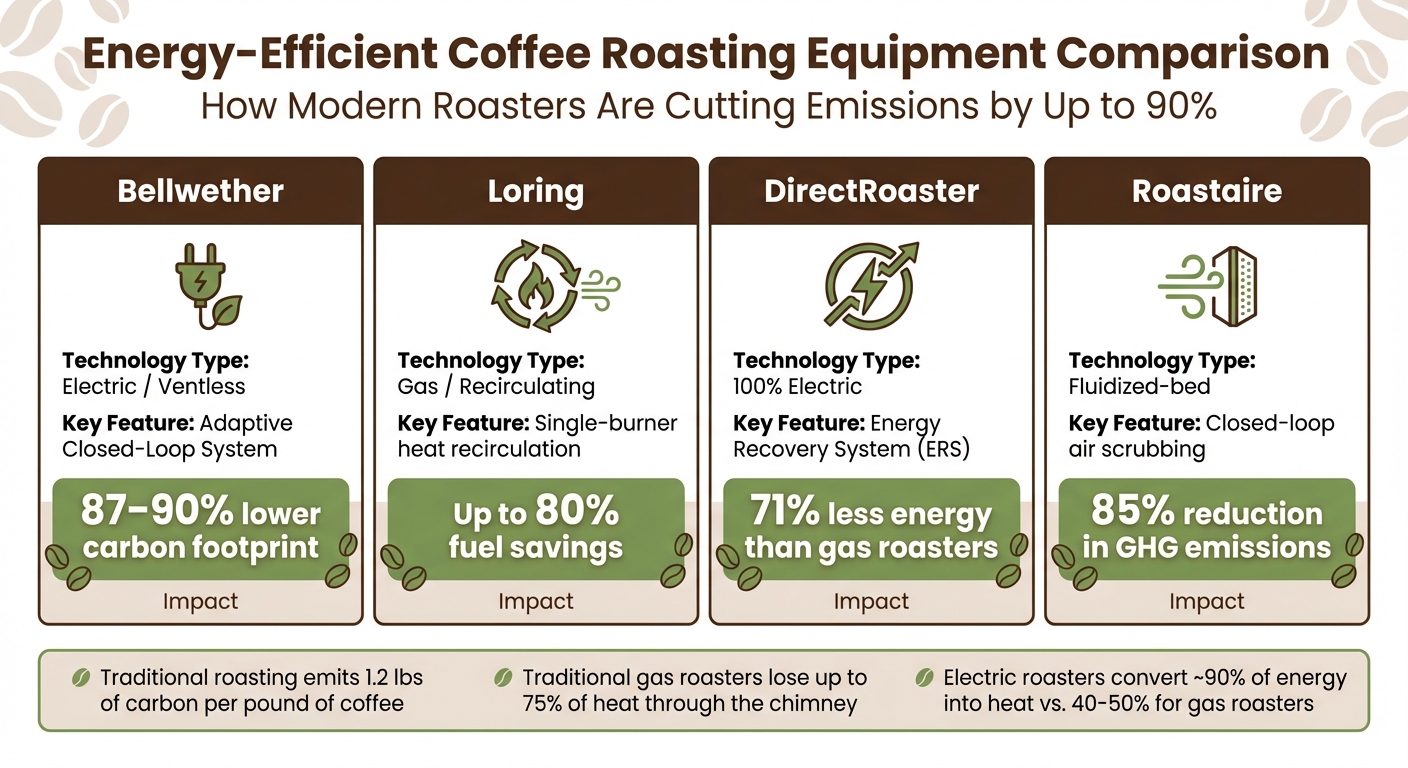
Energy-Efficient Coffee Roaster Comparison: Emissions and Fuel Savings
Once you've sourced sustainable coffee beans, the next step is tackling the roasting process. This stage, along with packaging and distribution, makes up about 15% of coffee's total carbon footprint. Traditional roasting methods release approximately 1.2 pounds of carbon emissions per pound of coffee and lose up to 75% of their heat through the chimney. However, zero-emission systems are changing the game by capturing and reusing thermal energy, switching to renewable energy sources, and eliminating harmful emissions. Cutting energy waste is just as vital as sourcing responsibly. Let’s dive into the equipment driving this shift.
Energy-Efficient Roasting Equipment
Electric roasters are leading the charge in reducing on-site fossil fuel use. When powered by renewable energy like solar or wind, they make carbon-neutral production possible. These roasters convert about 90% of energy into heat, compared to the 40–50% efficiency of traditional gas roasters.
Heat recirculation systems also play a big role in improving efficiency. For example, the Loring Smart Roaster captures heat from exhaust to preheat incoming air, reducing fuel needs by up to 80%. In October 2019, Kuma Coffee reported a 75% drop in gas usage after adopting a Loring Smart Roaster.
| Roaster Brand | Technology Type | Key Efficiency Feature | Reported Impact |
|---|---|---|---|
| Bellwether | Electric / Ventless | Adaptive Closed-Loop System | 87–90% lower carbon footprint |
| Loring | Gas / Recirculating | Single-burner heat recirculation | Up to 80% fuel savings |
| DirectRoaster | 100% Electric | Energy Recovery System (ERS) | 71% less energy than gas roasters |
| Roastaire | Fluidized-bed | Closed-loop air scrubbing | 85% reduction in GHG emissions |
Ventless systems are another innovation, eliminating the need for complex ventilation setups. Bellwether’s electric roasters use a closed-loop design to filter out smoke, volatile organic compounds (VOCs), and particulates internally - perfect for urban locations where traditional gas venting is impractical. By February 2022, Bellwether reported that its electric roasters had cut over 3 million pounds of carbon emissions in the coffee industry.
DirectRoaster’s production roaster, with a capacity of 1–10 kg (about 2.2–22 lbs), consumes just 0.3 kWh/kg (around 0.14 kWh/lb) as of March 2024. Its Energy Recovery System (ERS) reduces energy use by roughly 24% and shortens roast times by up to 10%.
"The transition to electric roasting is inevitable."
– James Hoffman, World Barista Champion and Author
When choosing roasting equipment, look for models with heat exchangers or recirculation systems to minimize wasted energy. Electric roasters often require only a standard 220V or 400V three-phase power supply, avoiding the expense and emissions of installing gas lines. Additionally, roasting at the optimal batch size recommended by the manufacturer ensures maximum energy efficiency. These advancements align perfectly with zero-emission goals.
Zero-Emission Roasting Techniques
Beyond equipment, zero-emission roasting methods aim to eliminate harmful outputs entirely. Traditional roasters use afterburners to incinerate pollutants, but these require extra fuel, increasing carbon emissions. Modern recirculating systems solve this by burning smoke, odors, and VOCs internally, removing the need for afterburners.
Fluidized-bed roasting, which uses heated air to roast beans evenly, is another eco-friendly method. When paired with closed-loop heat reclamation, it can cut energy use and greenhouse gas emissions by 85%. This approach also improves working conditions by reducing exposure to harmful substances like carbon monoxide, diacetyl (linked to "popcorn lung"), and green coffee dust.
"Carbon monoxide in particular is a potential respiratory hazard to workers in the coffee industry. Therefore, reducing emissions is an urgent challenge, a matter of 'must care' rather than 'should care'."
– Mihaela Iordache, Head Roaster, Belleville Brûlerie
In June 2024, Matt McDonald of Upcountry Coffee shared how they upgraded their Paia Sugar Mill roastery. They installed a VortX cyclone on their 40 kg (about 88 lbs) Italian Wampa roaster to filter out chaff and VOCs with atomized water. Additionally, they added a Loring S15 Falcon, which recirculates air at 1,200°F to burn emissions internally.
To achieve carbon neutrality, pair electric roasters with renewable energy sources or install solar panels. In 2021, Glen Lyon Coffee Roasters added 16 solar panels to their roof and upgraded to a more efficient 25 kg (approximately 55 lbs) roaster. They calculated their annual carbon emissions at 17,080 kg (around 37,600 lbs).
A study of Bellwether’s ventless electric technology found that a single machine could save over 157 metric tons (about 173 U.S. tons) of greenhouse gas emissions over 10 years - equivalent to taking nearly 390,000 vehicle miles off the road. These advancements mark a major step toward responsible coffee production.
"Our new roaster is a significant step in transforming the industry, making it more sustainable for the planet and accessible to all communities."
– Ricardo Lopez, Founder, Bellwether Coffee
Managing Byproducts: Coffee Chaff and Grounds
Coffee roasting produces an astounding 2 billion tons of byproducts every year globally. When these byproducts - like coffee chaff and spent grounds - are sent to landfills, they break down and release methane, a greenhouse gas far more harmful than carbon dioxide over a 20-year period. Properly managing these materials is just as important as sourcing and roasting specialty coffee when striving for a truly waste-free coffee process.
Roasting a single pound of coffee creates about half a cup of chaff, the lightweight, flaky skin that separates from the beans during roasting. On a larger scale, for every ton of coffee produced, about half a ton of chaff is generated. Instead of discarding it, many roasteries are finding inventive ways to reuse this nitrogen-rich byproduct. Let’s explore how coffee chaff and grounds can be repurposed effectively.
Reusing Coffee Chaff
Coffee chaff is a surprisingly effective addition to gardens and compost piles, thanks to its carbon-to-nitrogen ratio of 17:1 to 30:1, which classifies it as a "green" compost material. Adding it to garden soil improves structure, boosts aeration, and helps retain moisture. Plus, its texture and smell naturally repel common garden pests like slugs, snails, and ants.
Some businesses have taken unique approaches to reusing chaff. For instance, Pinup Coffee Co collaborates with Tidewater Compost to prevent chaff from ending up in landfills. The composting company uses it to enrich soil and support local organic waste programs. Meanwhile, Kōkako Organic Coffee Roasters in New Zealand turned chaff into a culinary feature, using it as a topping for ice cream.
One of the most creative examples comes from Ford Motors and McDonald’s. In 2019, the two companies partnered to convert McDonald’s coffee chaff into reinforced pellets mixed with resins and plastics. These pellets are then molded into car headlamp housings that are 20% lighter and require 25% less energy to produce than traditional materials.
"We looked up what we could do with all the chaff we were collecting - and once we started using it in our garden, we noticed a real difference. Our veggies were bigger, and our plants looked healthier all around."
– Jen, Co-owner, Gigawatt Coffee
When using chaff in your garden, it’s best to mix it into the soil rather than leaving it on the surface, as its light texture can cause it to blow away. If using it as mulch, apply it in thin layers to avoid creating a dense barrier that blocks water and oxygen from reaching plant roots. Additionally, chaff can be used as absorbent bedding for small animals like chickens or rabbits - just mix it with wood shavings to keep it from scattering.
But coffee byproducts don’t end with chaff. Spent coffee grounds are another material with plenty of potential.
Repurposing Coffee Grounds
Each year, the world generates an estimated 7.4 million tons of spent coffee grounds. Finding ways to reuse this byproduct is critical. Dried coffee grounds make excellent fertilizer for acid-loving plants such as roses, azaleas, and blueberries, providing essential nutrients while improving soil texture. If adding them to compost, limit grounds to 10–20% of the pile to avoid excess acidity or matting.
"Tossing used coffee grounds into the trash isn't just wasteful - it's an environmental misstep with serious consequences."
– Ryan Brooks, Coffee Expert
Coffee grounds have uses beyond gardening. They act as a natural abrasive for cleaning cookware and surfaces, removing stuck-on food without the need for harsh chemicals. Their porous structure also makes them great for neutralizing odors in refrigerators, shoes, and garbage bins. Even sweeping up ash from a fireplace becomes easier with damp coffee grounds, which help trap the ash and keep it from becoming airborne.
For personal care, spent grounds can be used as an exfoliant in body scrubs, face masks, and scalp treatments. They also work as a natural dye for paper, fabric, or even Easter eggs.
To store used coffee grounds, dry them thoroughly by spreading them on a baking tray overnight before placing them in an airtight container. This prevents mold, which can develop within 24 hours. Keep in mind, though, that coffee grounds should never be fed to pets, as residual caffeine can be toxic to animals. Also, avoid disposing of large amounts down drains, as this can lead to clogs.
Packaging and Shipping Coffee Responsibly
After tackling sustainable sourcing and roasting, the next step in a zero-waste coffee journey is thoughtful packaging and shipping. While packaging makes up about 47% of global plastic usage, coffee packaging contributes only around 3% of the coffee supply chain's carbon footprint. By choosing better materials and smarter shipping strategies, roasters can make a noticeable difference in reducing their impact.
The challenge lies in balancing product protection with eco-friendliness. Coffee requires packaging that blocks oxygen and moisture to maintain quality, but traditional multi-layer plastic laminates are nearly impossible to recycle. With food waste responsible for up to 10% of global greenhouse gas emissions, effective packaging is key to preventing spoilage. Just as reusing chaff and grounds rethinks waste in roasting, innovative packaging solutions are essential for a zero-waste approach.
Biodegradable Packaging Materials
Mono-material recyclable packaging is a practical option for roasters. These bags, often made from polypropylene, use a single type of plastic, making them compatible with soft-plastic recycling streams while still protecting coffee from oxygen and moisture.
Another impactful choice is post-consumer recycled (PCR) content, which replaces virgin plastics with recovered waste, cutting carbon emissions in the process.
Compostable materials, such as those made from PLA (polylactic acid) derived from corn starch or sugarcane, offer a greener alternative but come with trade-offs. PLA production uses significantly less energy and emits fewer greenhouse gases compared to conventional plastics. However, these materials require specialized handling: they need higher heat seal temperatures, shorter shelf lives (3–6 months), and industrial composting facilities to break down properly.
"There is no single 'most sustainable' coffee bag, but there is always a solution that offers improved sustainability over virgin plastic."
– Grounded Packaging
For compostable bags to be effective, every component must meet compostable standards - this includes the degassing valve, zipper, adhesive, and even printing inks. A bag isn’t fully compostable if any part, such as the valve, remains conventional plastic.
The ideal packaging depends on your business model and customer needs. Compostable bags are great for local or subscription-based sales where shorter shelf life isn’t a problem. For wholesale, export, or retail sales that demand longer shelf life, mono-material recyclable bags with PCR content often perform better environmentally.
"The most important thing you can do as a responsible coffee roaster is to understand the waste-management systems available to your consumers and design for those."
– Grounded Packaging
Reducing Shipping Impact
Packaging is only half the story - shipping practices matter just as much. Switching from corrugated boxes to mailers can reduce package volume by around 37% (from 114 to 72 cubic inches). This not only allows delivery vehicles to carry more packages per trip but also eliminates the need for filler materials like bubble wrap or air pillows.
Other simple changes can further cut waste. For instance, replacing paper receipts with digital records helps reduce the 90% of paper receipts that end up in the trash.
For roasters aiming for zero-waste goals, consider refill programs for local customers. Offering discounts to customers who bring reusable containers to your roastery can eliminate the need for single-use packaging entirely. While this approach requires extra logistics and may not fit every business model, it’s a meaningful step toward waste-free operations.
Lastly, carbon offsetting can support these efforts but should never replace the primary goal of minimizing packaging and shipping waste.
Conclusion
Zero-waste coffee roasting champions both environmental care and the dedication of the communities behind every coffee bean. Techniques like using energy-efficient roasters that reduce emissions by up to 90% and transforming coffee chaff into compost showcase how thoughtful practices can align with sustainability goals.
Moving forward, practical steps and strong partnerships are essential. Opting for mono-material recyclable packaging and fostering direct trade relationships with farmers help create a circular economy that benefits both people and the planet. Simple actions - such as setting up refill programs or donating chaff to local gardens - can forge meaningful connections within communities while keeping waste out of landfills. Together, these efforts provide a clear roadmap for a more sustainable coffee industry.
"Coffee is precious. We shouldn't normalize wasting it."
– Umeko Motoyoshi, Author of Not Wasting Coffee
Zero-waste roasting goes beyond technical improvements - it’s a reflection of ethical responsibility. This mindset naturally extends to community care and environmental respect. As Dr. Tracy McKenzie of Back Alley Coffee Roasters puts it:
"We want to treat this particular piece of God's creation in a way that honors the creator. God created it and gave us stewardship over it."
– Dr. Tracy McKenzie, Back Alley Coffee Roasters
By prioritizing sustainability, roasters aren't just safeguarding the environment - they're also ensuring the future of coffee-growing regions and supporting the livelihoods of farming communities.
With the coffee industry generating around 23 million tons of waste annually, redirecting at least 90% of that waste from landfills is within reach through intentional practices. Adopting the strategies in this guide - from mindful sourcing to eco-friendly packaging - empowers roasters to make a real impact while building brands that reflect their values.
At Brown Boot Coffee, our dedication to zero-waste roasting ensures that every cup delivers outstanding flavor while promoting environmental care and community well-being.
FAQs
What’s the easiest first step to start zero-waste roasting?
The simplest way to kick off a zero-waste roasting approach is by taking a closer look at your equipment and packaging. Opt for energy-efficient roasting machines - they’re designed to reduce both emissions and waste during the process. For packaging, switch to options like recyclable or compostable bags to cut down on environmental impact. Don't forget about byproducts like chaff; instead of discarding it, find ways to reuse or compost it. These straightforward steps can set you on the path to a more sustainable roasting operation.
Do electric roasters still need ventilation or afterburners?
Yes, electric roasters still need proper ventilation systems and afterburners to manage emissions such as VOCs, dust, and smoke. This becomes particularly crucial during lighter roasts to keep the environment smoke-free and maintain safety standards.
How can I reuse coffee chaff and used grounds safely?
You can make great use of coffee chaff and used coffee grounds, especially through composting. Coffee chaff, packed with nitrogen and trace nutrients, works wonders for soil health when combined with carbon-rich materials like dry leaves or straw. Used coffee grounds are another garden favorite - they can improve soil as an amendment, act as mulch, or even help deter pests. Both options are environmentally friendly, with composting standing out as the best way to recycle them while giving your plants and garden a boost.