


Faith and Integrity: Building Trust in Business
Trust is the backbone of business success. Companies that prioritize faith and integrity build stronger relationships with customers, employees, and partners. Faith guides decisions with values like honesty and compassion, while integrity ensures those values are consistently reflected in actions.
Key takeaways:
- Trust matters: 73% of consumers expect brands to act responsibly, but 71% doubt they'll follow through.
- Integrity builds trust: Actions aligned with values foster loyalty and simplify relationships.
- Broken trust is costly: A major breach can reduce trust by 25% in a month, and only 24% of companies recover within three years.
- Faith in practice: Companies like Chick-fil-A and Brown Boot Coffee demonstrate how values-driven decisions create long-term trust.
Stewardship or Scam? Why Christian Businesses Must Maintain Integrity.
sbb-itb-c3999cb
The Problem: How Broken Integrity Destroys Trust
When integrity is compromised, trust can unravel almost instantly, even if it took years to build. Research indicates that a major breach of trust can cause a 25% drop in trust within just one month. Even more striking, only 24% of companies manage to restore trust levels within three years after such an event.
Common Ethical Failures in Business
Patterns of ethical failures in business often follow predictable trends. Dishonest communication is one of the most common issues - whether it's lying to stakeholders, exaggerating product claims, or hiding known flaws. As Proverbs 11:1 reminds us, dishonest practices violate enduring ethical principles.
Another frequent issue is financial deception, which can appear as hidden fees, misleading fine print, or fraudulent financial reporting. One prominent example is Agrokor, a major food manufacturer in Southeast Europe. In 2017, the company collapsed after its massive debt and financial misreporting were revealed, resulting in a crisis that impacted 15% of Croatia's GDP and led to the resignation of the country's Minister of Economy. More recently, in November 2022, cryptocurrency exchange FTX imploded due to governance failures and misuse of client funds, causing $8.7 billion in losses and wiping out a $32 billion valuation.
Labor exploitation is another ethical failure that erodes trust internally. Practices like withholding wages, creating unsafe work environments, or using intimidation tactics violate basic ethical standards and mirror the Scriptural warning against exploiting workers. Similarly, broken commitments - such as failing to meet deadlines, reneging on promises, or altering deal terms - signal unreliability. Consultant Dave Kahle points out that such breaches force stakeholders to double-check every claim, wasting time and eroding confidence.
These failures highlight the sharp contrast between unethical practices and the values of integrity that should guide businesses, especially those grounded in faith-based principles.
How Broken Trust Affects Customers, Employees, and Partners
The consequences of ethical lapses ripple far beyond financial losses, affecting every relationship a business depends on. Customers who feel misled often walk away - and they don’t stay quiet about it. Once trust is broken, stakeholders shift their focus from evaluating competence to scrutinizing every action with suspicion. This "confirmation bias" means even neutral events can be misinterpreted as evidence of dishonesty.
Employees, too, are deeply affected. When leadership fails to uphold integrity, it fosters a culture of deceit rather than accountability. This is reflected in declining internal reporting of misconduct: in 2023, only 36% of financial services professionals said they would report unethical behavior to their boss, down from 43% in 2020. Poor treatment - whether through unfair wages or unsafe conditions - destroys morale and loyalty.
Business partners are also quick to withdraw when trust is damaged. Partnerships dissolve, growth slows, and opportunities dry up. Alarmingly, 80% of trust breaches stem from internal factors like poor judgment or misaligned processes, making the company itself responsible for the fallout. Warren Buffett’s words remain a timeless reminder:
It takes 20 years to build a reputation and five minutes to ruin it. If you think about that, you'll do things differently.
Proverbs 11:3 captures the essence of this issue: "The integrity of the upright guides them, but the perversity of the faithless destroys them". While cutting corners might offer temporary relief, it ultimately damages both the business and its reputation in the long run.
The Solution: Using Faith and Integrity to Rebuild Trust
Rebuilding trust after ethical missteps involves embracing principles rooted in faith and integrity. Christian business ethics establish what one source describes as a "higher standard", holding business owners accountable to God rather than solely to shareholders or fleeting social media trends. This accountability offers a solid foundation for decision-making, prioritizing values that transcend short-term profits and discouraging practices that undermine trust.
How Faith Guides Ethical Business Practices
Faith provides clarity in navigating complex business decisions. Leaders can lean on the "Three Questions" Framework to guide their choices: 1) Is it legal? 2) Is it balanced and fair to all involved? 3) Is it right - does it honor God?. This approach helps leaders focus on what truly matters, cutting through the distractions of competing interests and market demands.
Scripture reinforces this guidance. Proverbs 3:3-4 urges believers to "let love and faithfulness never leave you", promising that such a path will "win favor and a good name in the sight of God and man." Similarly, Colossians 3:17 advises:
Whatever you do, whether in word or deed, do it all in the name of the Lord Jesus.
These teachings inspire practical business practices like transparent pricing, honest marketing, and fair treatment of employees. For instance, Brown Boot Coffee demonstrates faith-driven values by supporting nonprofit organizations with every purchase, without passing additional costs to customers. This type of initiative showcases how faith can shape a business model that prioritizes service over profit. While faith provides the moral direction, integrity ensures these values are consistently upheld.
How Integrity Shows Christian Values in Action
Integrity takes the moral compass provided by faith and turns it into consistent, trust-building actions. It’s about demonstrating honesty, fairness, and uprightness in every aspect of business operations. Even small ethical lapses can erode trust and undo years of goodwill, making integrity essential for maintaining strong relationships.
The Bible ties this principle to God’s own unwavering character. Numbers 23:19 states:
God is not human, that he should lie, not a human being, that he should change his mind. Does he speak and then not act? Does he promise and not fulfill?
Business leaders are called to reflect this divine reliability by keeping their commitments, no matter the circumstances. For example, when a company admits to product flaws and promptly offers refunds or improvements, it mirrors the humility and restitution shown by Zacchaeus in Scripture. Such actions foster long-term loyalty, showing customers, employees, and partners that the company’s words and deeds are dependable.
How to Build Trust Through Faith and Integrity
Building trust means turning faith-based values into everyday actions. It's about creating systems that make integrity the norm, not just something to consider when problems arise.
Set Clear Ethical Standards
Start by establishing written ethical standards that guide everyone in the organization. A formal code of ethics should highlight values like honesty, integrity, and compassion, ensuring all employees know what's expected of them. This document can include scriptural references alongside practical actions. For instance, Proverbs 20:7 emphasizes the importance of walking in integrity.
But it’s not just about having a document - it’s about applying those principles. Use a simple three-question filter for big decisions: Is it legal? Is it fair? Does it honor God?. This approach simplifies decision-making while keeping teams aligned with core values. Additionally, regular audits of supply chains and partnerships can ensure these standards are upheld beyond the organization’s walls.
Once these guidelines are in place, the next step is demonstrating reliability in everyday operations.
Show Reliability in Daily Operations
Trust is built through consistent actions. Ethical standards mean little if they aren’t reflected in daily behavior. Trust grows when commitments are kept. The biblical principle of "letting your yes be yes" reminds us to follow through on promises and maintain high-quality standards. Customers notice when a business delivers what it promises - on time, at the agreed price, with no surprises or hidden fees.
Transparent pricing is another way to build trust. Clearly communicating costs upfront avoids deceptive practices that can erode trust and damage reputations. This kind of reliability reflects the divine trustworthiness described in Numbers 23:19, where God’s promises never fail.
Create a Faith-Based Company Culture
A strong company culture brings faith and integrity to life. It starts with servant leadership that puts the needs of others first. New hires should be trained on the company’s values through hands-on methods, like role-playing customer service scenarios, to see how faith translates into everyday actions. A great example is Habitat for Humanity, which requires its U.S. affiliates to tithe 10% of their unrestricted income to support global ministry efforts.
When conflicts arise, follow the "Matthew 18" model: address issues privately and directly before involving others. This encourages reconciliation and mutual respect instead of public disputes. Supporting employees’ spiritual growth - whether through prayer spaces, meditation, or Bible studies - can further strengthen integrity and foster a deeper connection to the company’s mission. When leaders consistently choose what’s right over what’s convenient, it shows that the company’s values aren’t just empty statements - they’re the foundation for every decision.
The Results: Long-Term Benefits of Faith-Driven Integrity
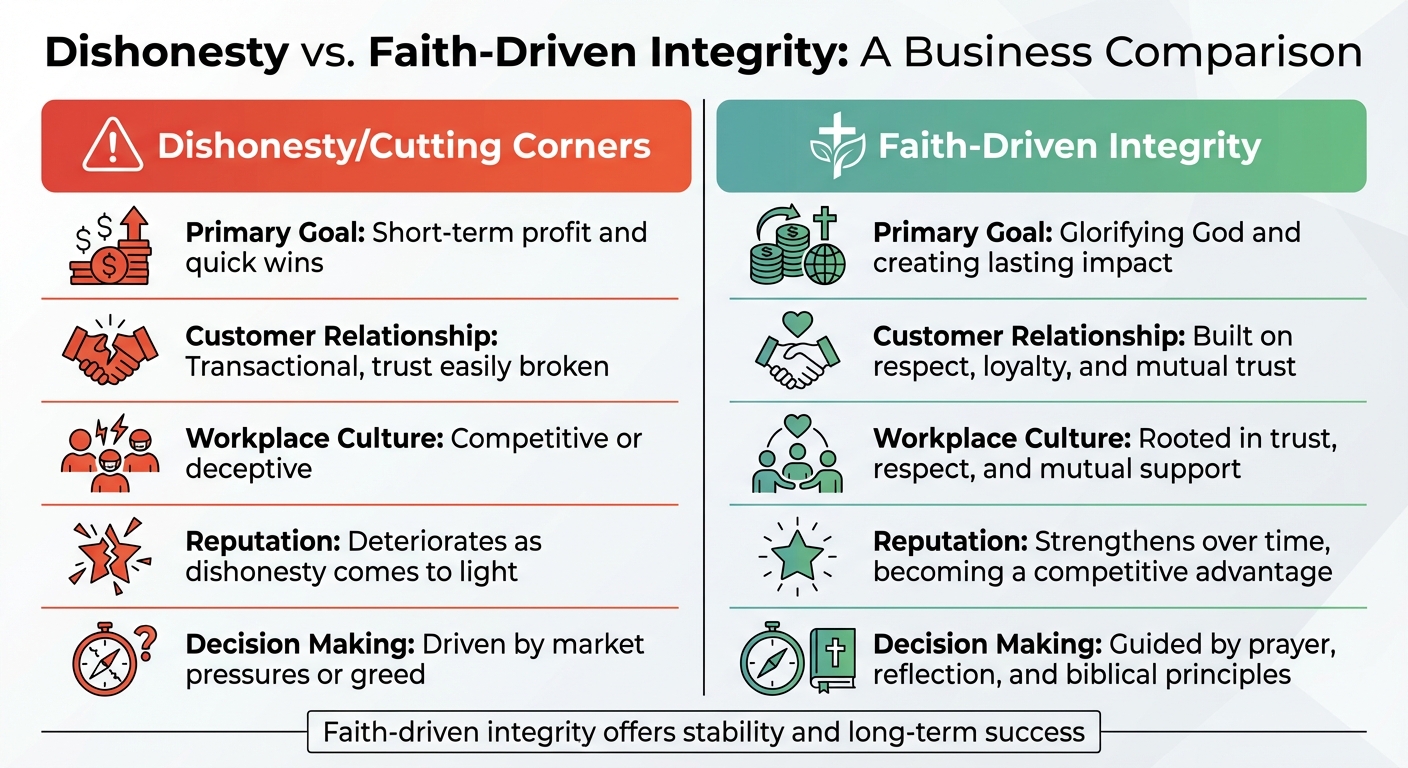
Dishonesty vs Faith-Driven Integrity in Business: Key Differences
When businesses consistently operate with faith-driven integrity, the benefits extend far beyond immediate financial gains. Trust becomes a cornerstone, simplifying transactions and speeding up decision-making processes, as less time is spent on verification and more on building meaningful relationships.
Internally, the advantages are just as impactful. Employees in such environments often report greater job satisfaction and loyalty, reducing turnover costs and fostering stronger, more cohesive teams. These workplaces naturally attract individuals who share similar values, creating a unified culture. Over time, a reputation built on faith and integrity becomes a powerful advantage in even the most competitive markets.
Dishonesty vs. Faith-Driven Integrity: A Comparison
| Feature | Dishonesty / Cutting Corners | Faith-Driven Integrity |
|---|---|---|
| Primary Goal | Focused on short-term profit and quick wins | Aims for glorifying God and creating lasting impact |
| Customer Relationship | Transactional, with trust easily broken | Built on respect, loyalty, and mutual trust |
| Workplace Culture | Often competitive or deceptive | Rooted in trust, respect, and mutual support |
| Reputation | Deteriorates as dishonesty comes to light | Strengthens over time, becoming a competitive advantage |
| Decision Making | Driven by market pressures or greed | Guided by prayer, reflection, and biblical principles |
While businesses that rely on dishonesty may enjoy short-term success, their reputation often crumbles over time, making recovery difficult. On the other hand, faith-driven integrity offers stability, even in uncertain markets, by providing a moral framework that helps leaders navigate challenges. This contrast highlights how integrity grounded in faith fosters trust and long-term success.
Creating a Legacy of Trust
For faith-driven businesses, success is often measured by the positive impact they leave on their communities. These companies align their operations with biblical principles, using their success not just for profit but to support charitable causes and contribute to the greater good. Tanya Akimenko, Founder of Christian Business Sisterhood, captures this sentiment perfectly:
Integrity is an ongoing journey in business... Your commitment to integrity will not only enhance your reputation but also pave the way for long-term success.
Take Brown Boot Coffee, for example. Their dedication to faith-driven practices goes beyond selling specialty coffee. By supporting nonprofits with every purchase and maintaining transparent operations and ethical sourcing, they demonstrate how purpose-driven goals can coexist with business excellence. Their actions consistently reflect their Christian values, creating a foundation of trust that resonates with customers, employees, and partners alike. This alignment between values and actions is what builds a legacy that lasts for generations.
Conclusion: Faith and Integrity as the Foundation of Trust
Trust grows through consistent actions rooted in faith and integrity. When businesses prioritize honesty, transparency, and responsible stewardship, they build relationships that can weather market challenges and economic shifts. Proverbs 10:9 says it well: "Whoever walks in integrity walks securely". This sense of security fosters loyal customers, committed employees, and partnerships based on respect rather than mere transactions.
Businesses constantly face a choice: chase short-term profits or focus on building a lasting legacy. Integrity driven by faith isn't just about avoiding dishonesty - it's about living out Christian values in every aspect of business, from supply chain decisions to employee well-being. As Christian Business Coach Erin Harrigan puts it, "Modest success with integrity trumps compromising values for profit". This mindset creates a reputation that attracts like-minded individuals who want to be part of something bigger than themselves. It's a competitive edge that no amount of money can replicate, and it's already being practiced by faith-driven companies.
Take Brown Boot Coffee, for example. Founded in 2024 by Luke and Haley, the company weaves faith into every part of its business. For every bag of coffee sold, a portion of the profits is automatically donated to nonprofit organizations - without any added cost to the customer. This is stewardship in action. As Luke explains, "Brown Boot Coffee was started in 2024 with the desire to create a business that has a positive impact on its employees, customers, and the world around us (and not just say it)". Their approach shows how faith-based decisions can leave a lasting mark.
Every small decision grounded in faith and integrity strengthens the foundation of trust. Whether it's setting ethical standards, being transparent with stakeholders, or incorporating charitable giving, these actions reflect a commitment to something greater. This dedication turns a business into a legacy that honors God and serves others, creating a ripple effect of good far beyond financial results.
FAQs
How can I rebuild trust after a mistake?
Rebuilding trust starts with acknowledging mistakes and proving your commitment to change through consistent, transparent actions. This means taking full responsibility for errors, delivering on promises, and addressing concerns without delay. For a business like Brown Boot Coffee, living out values like honesty, openness, and reliability not only reflects Christian principles but also strengthens trust with customers, employees, and partners. These efforts lay the foundation for lasting relationships rooted in integrity.
How do I apply the “three questions” test at work?
To use the “three questions” test in the workplace, aim to build trust by encouraging openness, sharing hope, and providing evidence of understanding. Here are the questions to ask:
-
Where did you grow up?
This helps you get a glimpse into someone's background and the values that shaped them. -
How many siblings do you have, and where do you fall in the order?
A simple way to uncover relational dynamics and how they might approach interactions. -
Describe a unique childhood challenge or experience.
This reveals their resilience and offers a window into their character.
The goal here is to create meaningful connections, not just surface-level conversations. These questions can pave the way for deeper understanding and stronger relationships.
What systems make integrity consistent every day?
Integrity thrives when built on a foundation of ethical practices and principles drawn from biblical teachings. It involves key habits like transparency, keeping promises, and showing respect to everyone. Regular self-reflection and staying true to core values play a big role in maintaining accountability. For instance, Proverbs 11:1 emphasizes the importance of honest measures, while Matthew 5:37 encourages straightforward communication. By applying these teachings, leaders can create an environment where faith and integrity are not just ideals but everyday practices.