


Balancing Faith and Profit in Business
For Christian entrepreneurs, running a business isn't just about making money - it's about aligning operations with faith. The key? Viewing yourself as a steward of God's resources. This mindset transforms business decisions into opportunities to honor God while ensuring sustainability. Here's how faith and profit can work hand in hand:
- Faith shapes decisions: Biblical principles like integrity and service guide pricing, employee treatment, and customer interactions.
- Profit supports stewardship: Financial success enables fair wages, charitable giving, and community support.
- Purpose drives actions: A clear mission grounded in faith ensures decisions align with Kingdom values.
- Prayer provides clarity: Seeking God's wisdom helps navigate challenges and stay true to biblical ethics.
- Generosity creates impact: Businesses can integrate giving into their models, turning profit into a tool for good.
Balancing faith and profit isn't a trade-off; it's about using business as a platform to serve others and reflect God's character.
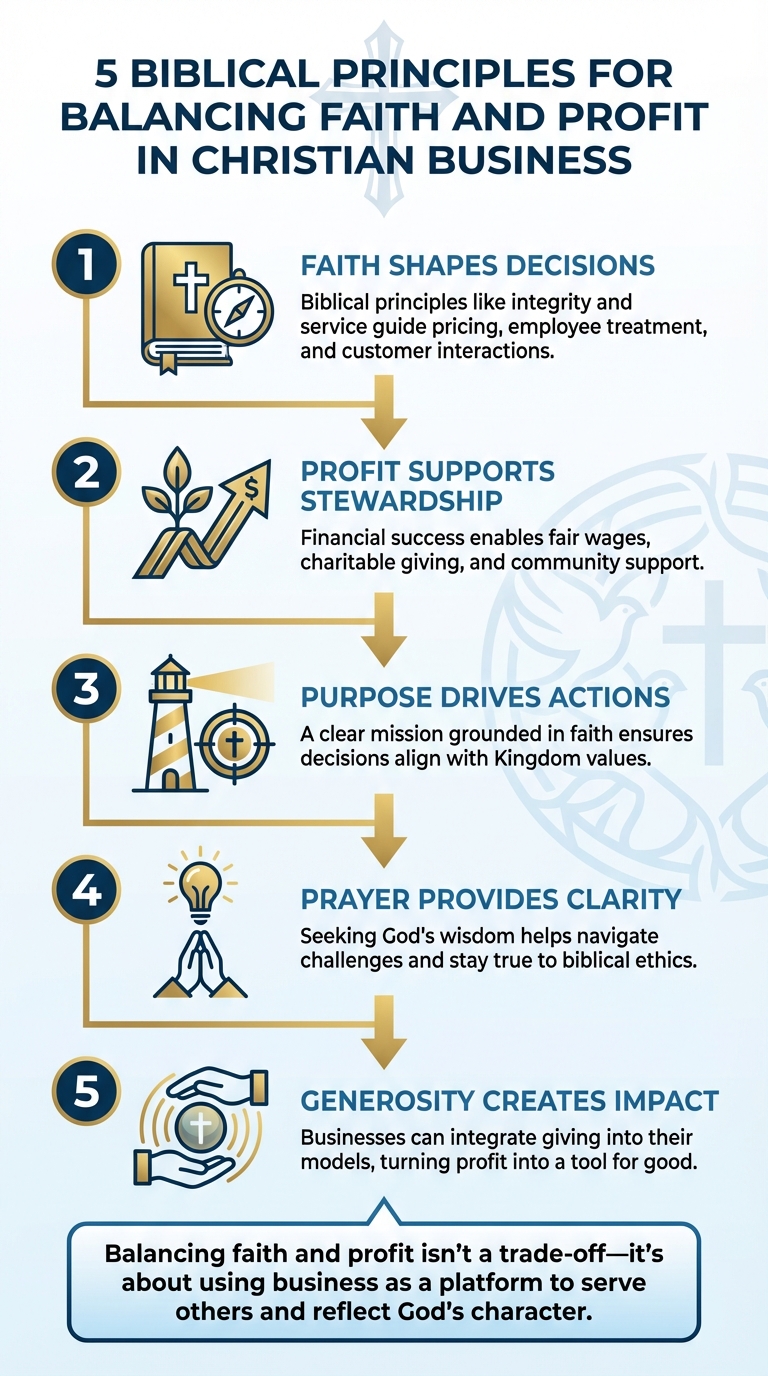
5 Biblical Principles for Balancing Faith and Profit in Christian Business
How I’d grow a faith-led business from scratch (as a 7-figure work from home mom)
sbb-itb-c3999cb
Creating a Purpose-Driven Mission
A mission statement serves as your guiding light. As Zig Ziglar once said:
If you aim at nothing, you will hit it every time.
Without a clear and faith-centered mission, businesses can lose their way. While vision explains your "why", your mission defines the "how."
Take inspiration from companies like Hobby Lobby, whose mission reads:
Honoring the Lord in all we do by operating the company in a manner consistent with biblical principles.
Or Chick-fil-A, which states:
To glorify God by being a faithful steward of all that is entrusted to us and to have a positive influence on all who come into contact with Chick-fil-A.
These mission statements are more than words - they inform every business decision, from hiring to customer service.
Using Prayer to Find Your Business Purpose
Prayer is not just a spiritual practice; it’s a strategic tool for seeking direction in your business. Through a cycle of praying, listening, and acting in faith, you can discern your business’s purpose. Ask specific questions during prayer, such as, "What challenges or needs has God positioned my business to address?" or "How have my experiences equipped me to serve in this area?"
Focus on what excites and motivates you rather than what feels draining. Look for the needs that spark your desire to take action. Recognize that every business interaction is an opportunity to reflect God’s character. As Mitera Branding explains:
Your business isn't just a way to fund ministry - it IS ministry.
Whether it’s through your products, services, or client relationships, every aspect of your business can become a platform for demonstrating God’s love and values.
Following the advice in Habakkuk 2:2, write your mission clearly so it can inspire and guide everyone involved. Regularly revisit it to ensure it continues to align with biblical principles like service, integrity, and stewardship as your business evolves.
By combining a well-defined mission with prayerful guidance, you can weave Kingdom impact into every part of your business.
Supporting Kingdom Work Through Your Business
Once your mission is clear, the next step is to incorporate Kingdom-focused generosity into your business model. This means making intentional choices to give back - whether through donating a portion of profits, supporting causes that align with biblical values, or offering free services to local charities. Generosity transforms your business into a tool for positive change.
Brown Boot Coffee is a great example of this approach. Every purchase from their shop supports nonprofit organizations at no extra cost to the customer. Their partnership roasts, like Budaka Bold ($25.00) and Mayuge Morning ($25.00), directly contribute to Musana’s mission, turning each cup of coffee into an act of service and inviting customers to join in Kingdom work.
What sets a Kingdom business apart from a secular social enterprise is its foundation and purpose. While both aim to do good, a Kingdom business is rooted in biblical principles and guided by a desire to glorify God. Decisions are shaped by prayer and Scripture, not just data or market trends. Success is measured not only by financial gains but also by the lives touched, communities uplifted, and the reflection of God’s character in daily operations.
Applying Biblical Ethics in Business
Once you've established a mission rooted in purpose, the next step is to bring biblical principles to life in your business. This involves making choices in areas like pricing, marketing, and transactions that honor God - even when the pressure to take shortcuts is strong.
Biblical ethics aren't just about avoiding wrongdoing like fraud or theft. They call for actively practicing fairness, honesty, and a spirit of service in every business interaction.
Maintaining Integrity in Business Transactions
Integrity in transactions is a cornerstone of ethical business practices. Proverbs 11:1 offers a clear directive:
A false balance is an abomination to Jehovah, but a just weight is his delight.
In biblical times, merchants used scales to measure goods, but some would manipulate these tools to deceive customers. Modern parallels include deceptive pricing, misleading advertisements, or exploiting customers' lack of knowledge. Upholding fair pricing involves balancing the true value of your product or service with the benefits it provides to customers, all while responsibly managing the skills and resources God has entrusted to you. Overcharging compromises honesty, while undercharging can reflect poor stewardship.
Practices like price gouging or exploiting vulnerable situations go against biblical teachings. Amos 8:4–6 warns against taking advantage of the needy, and John the Baptist’s advice to tax collectors - "Collect no more than you are authorized to do" - reinforces the importance of fairness. Whether you're setting consulting fees, pricing products, or negotiating contracts, transparency should guide your actions. Marketing should honestly portray both the strengths and limitations of what you offer, following Jesus' words in Matthew 5:37: "Let your 'yes' be 'yes,' and your 'no,' 'no.'"
If mistakes occur - like pricing errors or questionable practices - take inspiration from Zacchaeus in Luke 19 by making restitution promptly. The Golden Rule from Matthew 7:12 - treating others as you want to be treated - should shape your interactions with clients, vendors, and suppliers. By maintaining this level of ethical rigor, you not only build trust but also fulfill your broader mission of being a faithful steward of God's resources.
Seeking God's Wisdom Through Daily Prayer
Some decisions go beyond clear-cut ethical guidelines, requiring deeper discernment. Daily prayer becomes essential for navigating these complex choices. Market pressures, competition, and financial stress can cloud judgment, but prayer serves as both a spiritual discipline and a tool for clarity.
James 1:5 provides a reassuring promise:
If any of you lacks wisdom, you should ask God, who gives generously to all without finding fault, and it will be given to you.
Through prayer, you shift your mindset from being just a business owner to becoming a steward of God's work. Before making decisions, ask yourself, "Does this align with God's values, or does it simply serve my personal goals?" Consulting with a pastor, mentor, or trusted peers can also help you discern God’s wisdom from your own biases.
Proverbs 3:5–6 encourages us:
Trust in the Lord with all your heart and lean not on your own understanding; in all your ways submit to him, and he will make your paths straight.
While data, ROI, and market trends provide the "what", prayer helps clarify the "why" and "how", ensuring your actions reflect God's will. Combining practical knowledge with spiritual guidance leads to sound ethical decisions. Taking regular time for rest and renewal is equally important - not just as an observance but as a way to resist the relentless drive of hustle culture. Grounding yourself in Colossians 3:23 reminds you to work for the Lord, not merely for human approval. When you commit your plans to God through prayer (Proverbs 16:3), decisions become clearer, and you gain the strength to walk away from opportunities that conflict with biblical values.
Many businesses embody these principles. For instance, Brown Boot Coffee (https://brownbootcoffee.com) operates with a commitment to fairness, transparency, and service. Their approach shows that balancing faith and profit is not only possible but can also leave a lasting impact on both customers and the community.
Building a Servant Leadership Culture
Servant leadership turns the usual leadership model upside down. Instead of seeking personal gain, it emphasizes prioritizing the well-being of your team. This concept is rooted in Jesus' example, as seen in Mark 10:45:
For even the Son of Man did not come to be served, but to serve, and to give his life as a ransom for many.
The foundation of servant leadership begins with understanding that you're managing resources entrusted to you by God. C.S. Lewis captured this idea beautifully:
See the face of Christ in every man and act accordingly.
When you treat others with the same care and respect you'd show to Jesus, your commitment to service and excellence naturally deepens. This mindset extends seamlessly to both employees and customers.
Caring for Employees and Customers
Servant leadership asks, "How can I serve you?" rather than focusing on what others can do for you. Companies that embrace this approach often see 50% better employee retention and a 6% boost in job performance. A key step is creating opportunities for open communication. For instance, one-on-one meetings allow employees to discuss challenges and goals. James 1:19 reminds us to be:
quick to listen, slow to speak.
Support your team’s growth by offering training programs, mentorship, and resources that go beyond their immediate roles. Some businesses even set up care funds to assist employees and their families during tough times, reinforcing the inherent worth of every individual.
For customers, build relationships that go beyond transactions. Be honest in your marketing by clearly stating both the strengths and limits of your product. Mistakes are inevitable, but addressing them quickly and fairly strengthens trust and shows a commitment to long-term relationships over short-term profits.
Making an Impact Through Community Giving
As you nurture a culture of service within your business, extend that mindset to your community. Dedicate a portion of your income to support local or global ministries. For example, Habitat for Humanity’s U.S. affiliates contribute 10% of their unrestricted income to global ministry efforts.
Look for specific needs in your community - whether it’s food banks, job training initiatives, or environmental projects - and collaborate with local organizations or churches to address those gaps. Form a ministry team within your company to lead outreach efforts and manage giving budgets. This approach not only amplifies your impact but also creates a shared sense of purpose among your team.
Take inspiration from businesses like Brown Boot Coffee, which integrates mission work into its operations. Their blends, such as Budaka Bold and Mayuge Morning, directly support nonprofit initiatives, proving that community impact can be woven into everyday business activities.
Ultimately, when you view your work as an act of worship, everything changes. Colossians 3:23 reminds us:
Whatever you do, work at it with all your heart, as working for the Lord, not for human masters.
Using Profit for Kingdom Impact
Profit isn't just about financial gain - it's a tool to further Kingdom work. The C12 Editorial Team captures this idea perfectly:
God is less concerned about the percent you give from the business than He is about how you steward 100% of what He has given you.
Before directing profits toward faith-based initiatives, ensure your business is financially stable. Cover essential costs like payroll, rent, utilities, taxes, and insurance. Build reserves for growth, emergencies, and equipment upgrades. Overextending generosity without a solid financial foundation can jeopardize your ability to sustain long-term impact. Stability provides the groundwork for deliberate reinvestment in initiatives aligned with your mission.
Reinvesting in Faith-Based Initiatives
Once your business achieves financial security, you can focus on reinvesting profits strategically. A thoughtful giving strategy is key. One approach is the "retained earnings model", where a fixed percentage, such as 10%, of the previous year's retained earnings is allocated to ministries or charities. Marty VanDriel, CEO and Assistant Editor, explains:
Ten percent of last year's retained earnings is a clear expectation, and one that can be easily communicated and measured.
This model avoids double-tithing, as business owners already tithe on personal income, while maintaining accountability. Reviewing this allocation during annual shareholder meetings ensures transparency and allows for adjustments based on the business's performance.
Non-cash contributions can also make a meaningful difference without straining cash flow. Consider donating assets like securities, equipment, or business interests to benefit from tax advantages. Leasing unused office space to nonprofits or creating "lease-back" arrangements - where equipment is donated to a ministry and leased back - can also turn routine expenses into consistent funding streams.
Creating a Ripple Effect of Generosity
Generosity woven into daily business operations amplifies your mission and inspires others. Purpose-driven giving becomes a visible testimony, influencing employees, customers, and vendors. For example, you could invite customers to round up their purchases at checkout or encourage vendors to match donations, multiplying the overall impact.
Brown Boot Coffee provides a great example of this ripple effect. Their blends, like Budaka Bold and Mayuge Morning, support nonprofit initiatives while inspiring customers to view their purchases as part of Kingdom work. This approach builds a community of givers, extending the mission far beyond each individual transaction.
You can also use your business to provide opportunities for people facing employment challenges, such as individuals with special needs. Consider the extra training time an investment in human dignity - a form of non-financial tithing. Sharing these stories on social media can raise awareness for important causes and inspire others to act. When generosity becomes a core part of your business culture, its influence extends far beyond your immediate circle, creating a lasting ripple effect.
Overcoming Challenges with Faith and Accountability
Running a faith-driven business often means navigating tough situations where your principles and profitability seem to collide. Whether it's a tempting opportunity that conflicts with your values or financial struggles that challenge your trust in God's provision, these moments test your commitment to biblical wisdom. But they don’t have to derail your mission.
Common Challenges for Faith-Driven Businesses
Christian entrepreneurs frequently face ethical pressures. The temptation to cut corners - whether through misleading advertising, hidden fees, exploitative contracts, or exaggerating capabilities - can feel overwhelming, especially when cash flow is tight. Yet, data shows that businesses grounded in strong biblical ethics often experience better profitability and employee retention.
Take the example of Bandwidth, a company led by Henry Kaestner. At a critical moment, when the business's survival depended on securing a contract, they discovered that a potential client was affiliated with the adult entertainment industry. Despite the financial risk, Kaestner and his team chose to walk away from the deal to stay true to their biblical principles. Their decision paid off in the long run - Bandwidth went on to become the fourth-fastest-growing privately held company in the U.S.. Proverbs 16:8 offers a fitting reminder:
Better is a little with righteousness than great revenues with injustice.
Stories like this highlight the importance of accountability when facing ethical dilemmas. Joining a faith-based peer group or seeking mentorship can provide the guidance and support you need to remain aligned with God’s wisdom. Before making major decisions, it helps to ask yourself: Does this honor God? Is it fair to everyone involved? Would I be comfortable if this decision were made public?. These questions serve as a compass, keeping your business on the path of integrity.
Trusting God's Promises During Hard Times
Financial struggles often reveal where your trust truly lies. When the numbers don’t add up and the pressure feels unbearable, it’s crucial to remember that your business is ultimately God’s, not yours. This perspective shifts the weight of responsibility off your shoulders and onto His. Proverbs 3:5–6 encourages us:
Trust in the Lord with all your heart and lean not on your own understanding; in all your ways submit to him, and he will make your paths straight.
Practical steps can help you stay grounded during these tough times. Start your day with prayer to ensure your decisions come from a place of peace, not panic. Continue practicing generosity, even when it feels counterintuitive - this breaks the cycle of fear and reinforces your trust in God’s provision. Scriptures like John 16:33 and Psalm 37:5 remind us that peace is possible even in the midst of challenges and that committing your plans to God leads to results. As Christian Coach Collab wisely puts it:
With God as your CFO, profit becomes a servant - not a master. And peace becomes your default - not your desperate prayer.
Maintaining Growth with Stewardship and Reflection
Building on the idea of aligning business practices with biblical stewardship, achieving sustainable growth requires shifting your mindset from ownership to stewardship. This perspective emphasizes that all resources ultimately belong to God. Dr. Letta Campbell highlights this beautifully:
The starting point for me is the Bible. If you really look at the parables, and you really look and understand the importance of leading and working, you understand that it comes from a value-driven system.
Success, then, is not just about results but about faithfully managing the resources God has entrusted to you. Leaders bear the responsibility of stewarding these gifts with care and accountability.
The next step? Learning how to measure progress in a way that reflects both faith and purpose while planning for meaningful, lasting impact.
Tracking Your Faith-Driven Goals
While most entrepreneurs focus on revenue and expenses, faith-driven businesses thrive when they broaden their metrics. Tom Rivers, Principal Chair at C12 Greater Detroit, explains:
Scripture tells us that being a steward means faithfully managing everything God entrusts to us: not only money but also resources, relationships, reputations, and even opportunities.
To evaluate performance holistically, consider using a 5-Point Alignment Assessment, which covers areas like Revenue Generation, Operations Management, Organizational Development, Financial Management, and Ministry. Pair this with quarterly "heart checks" to seek God’s guidance, reassess your goals, and adjust your strategies from a spiritual perspective. Reflecting on how God has guided your business in the past can also provide encouragement during tough seasons.
Financial systems are another key part of stewardship. The Profit First method, for example, helps businesses manage cash flow while setting aside funds for taxes, tithing, and reinvestment. Proverbs 21:5 offers timeless wisdom in this regard:
The plans of the diligent lead to profit as surely as haste leads to poverty.
But stewardship isn’t confined to financial metrics. Track Kingdom metrics as well - such as lives impacted, stories of transformation, and community contributions - alongside traditional financial data. For instance, the 2025 Edelman Trust Barometer revealed that 61% of people globally believe government and business primarily serve the wealthy and powerful. By operating with radical honesty and transparency, faith-driven businesses can build the trust and loyalty needed for long-term growth.
Once you have a clear picture of your current progress, you can focus on strategies for sustainable, mission-driven growth.
Planning for Long-Term Impact
When growth is motivated by serving others and advancing Kingdom work rather than personal ambition, it becomes a powerful form of stewardship. God calls for multiplication, not simply maintaining the status quo. Calvin Chan, a business leader and author, puts it this way:
The question should never be, 'How much of my money should I give to God?' but rather, 'How does God want me to manage His money?'
Before pursuing expansion, test new markets to ensure growth remains manageable and purposeful. Invest in scalable tools, such as CRM and inventory management systems, to support operational excellence while staying true to Kingdom values. At the same time, prioritize the spiritual and professional development of your team over financial results. Regular vision alignment meetings can help ensure that your growth stays connected to your mission.
Seeking wise counsel is equally important. Surround yourself with trusted mentors or spiritual advisors to guide major decisions. As Proverbs 15:22 reminds us:
Plans fail for lack of counsel, but with many advisers, they succeed.
Think beyond your immediate goals by planning generationally. Proverbs 13:22 speaks to this vision: building wealth that can serve as an inheritance for future generations while also funding long-term Kingdom initiatives like missions. Darren Shearer, Director of the Theology of Business Institute, offers this eternal perspective:
If it doesn't last in eternity, it's not the bottom line
Businesses like Brown Boot Coffee illustrate how integrating stewardship principles into every aspect of operations can lead to growth that is both purposeful and enduring. Your business exists for more than profit - it’s a platform to honor God, create wealth, and serve the community through Christian values. When viewed through this lens, growth becomes an act of worship, not just ambition.
Conclusion: Balancing Faith and Profit for Eternal Impact
Balancing faith and profit doesn’t mean choosing one at the expense of the other - it’s about understanding that profitability can be a powerful tool for advancing Kingdom purposes. When you see your business as a matter of stewardship rather than ownership, every dollar earned becomes a chance to serve others, care for your family, and support faith-driven initiatives. As James 2:17 reminds us:
Faith by itself, if it is not accompanied by action, is dead.
Your business becomes the tangible expression of that action.
Incorporate daily prayer, uphold biblical principles, and lead with a heart committed to serving others. Set fair prices that reflect both your value and the biblical principle that "the worker deserves his wages" (1 Timothy 5:18). Regularly evaluate your business practices to ensure they align with your faith values.
By taking these steps, you can redefine success as something measured by obedience, integrity, and the lives you touch. James, a fellow Christian entrepreneur, put it this way:
God doesn't want you to choose between serving him and being successful. He wants your success to be a testimony of his faithfulness.
When you embrace this perspective, your business becomes a beacon of light, like "a city on a hill" (Matthew 5:14-16).
Excellence in your work is also an act of worship. Proverbs 22:29 reminds us:
Do you see someone skilled in their work? They will serve before kings.
Delivering high-quality service not only builds trust but also honors God. Surround yourself with a community of Christian entrepreneurs who can hold you accountable and keep your focus on Kingdom goals.
Through faithful stewardship, profit transforms into eternal impact. By practicing "first fruits" giving - setting aside a portion of your earnings for charitable work - you create a ripple effect of generosity that reaches far beyond your immediate circle. Commit your plans to the Lord, trusting that He will guide and establish them, as Proverbs 16:3 encourages.
Examples of this balance are all around us. At Brown Boot Coffee, we strive every day to merge purpose with profit, showing how faithful stewardship can turn each decision into an opportunity for Kingdom impact. The balance you’re looking for isn’t about perfect strategies - it’s about taking one faithful step at a time.
FAQs
How can I set prices ethically while staying profitable?
To set prices that reflect both ethical practices and profitability, it's essential to evaluate the real worth of what you offer. This includes accounting for your costs, the time invested, and the expertise you bring to the table. At the same time, staying rooted in Christian values - such as honesty, fairness, and responsible stewardship - is key. Be upfront about your pricing structure, ensuring it reflects both fairness and integrity. By aligning your approach with these principles and relying on God’s provision, you can create a business model that honors your faith while maintaining financial sustainability.
What should I do when a lucrative deal conflicts with my faith?
When faced with a deal that challenges your faith, it’s important to put your spiritual integrity and ethical values first. Take a moment to assess whether the opportunity aligns with biblical teachings and your personal convictions. If it pushes you toward compromising your morals or participating in unethical actions, walking away is the better choice. While staying committed to your beliefs might come with sacrifices, it preserves your integrity, honors your relationship with God, and strengthens a reputation grounded in Christian principles.
How can I build giving into my business without hurting cash flow?
Incorporating giving into your business starts with setting a clear goal - like donating a specific percentage of net profits - and including it in your budget. By planning ahead, you can ensure your contributions remain consistent without putting unnecessary pressure on your cash flow. Additionally, making generosity a core value of your business allows you to leverage resources such as revenue and relationships to make a difference. This approach not only supports meaningful causes but also aligns with principles of stewardship and purpose, all while maintaining financial stability.