


Kingdom Business Principles for Everyday Work
Work is more than just a job - it’s an opportunity to honor God. Kingdom business principles, drawn from Scripture, transform daily tasks into acts of worship. These principles focus on:
- Integrity: Be honest and transparent in all dealings.
- Stewardship: Manage resources as gifts from God.
- Servant Leadership: Lead by serving others, prioritizing people over profits.
- Generosity: Use profits to bless others and advance God’s mission.
Practical examples include starting each day with prayer, aligning decisions with eternal values, and creating a workplace that reflects Christ-like love and justice. Whether running a small business or working in a corporate setting, these principles help you integrate faith into your work, making it meaningful and God-centered.
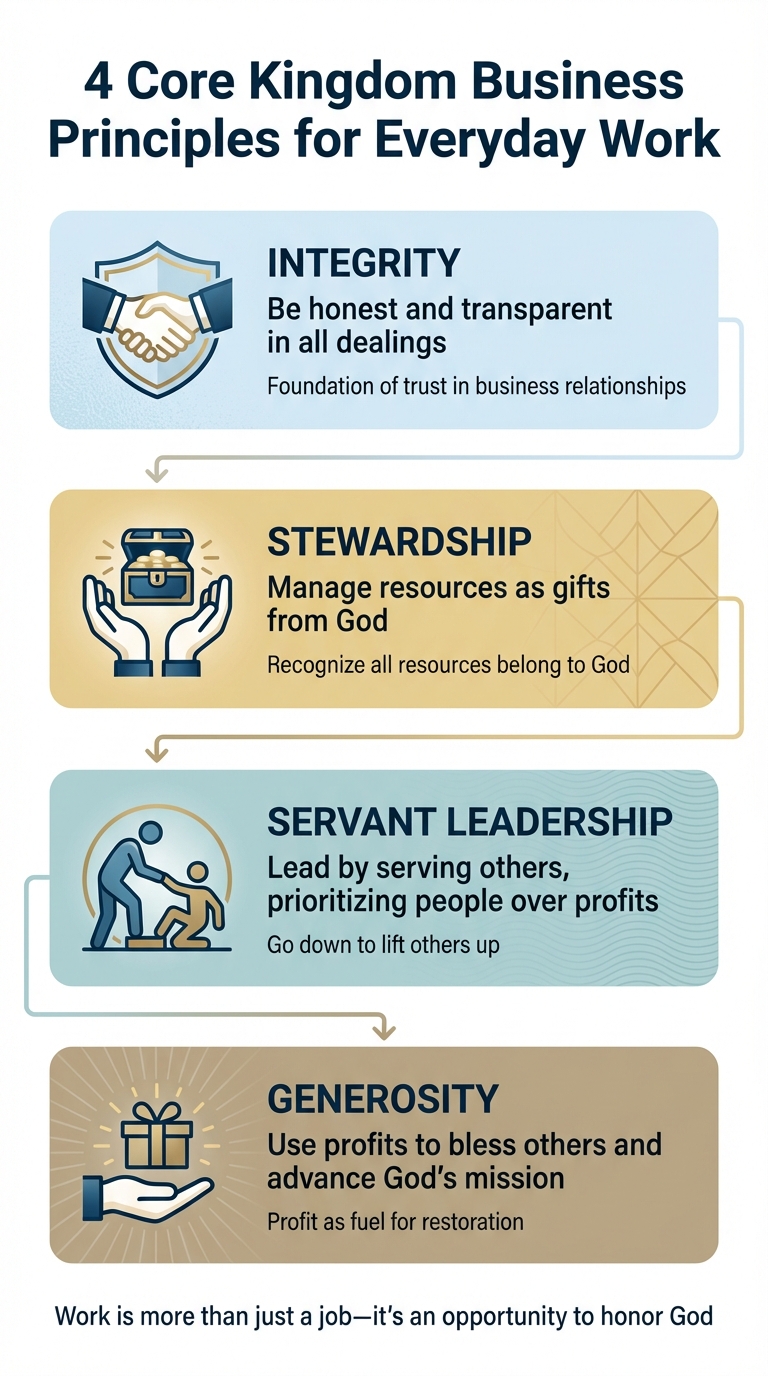
4 Core Kingdom Business Principles for Faith-Driven Work
Kingdom Principles for Business: Honoring God in Your Work Life
sbb-itb-c3999cb
Core Kingdom Principles for Everyday Work
Understanding Kingdom business principles provides a framework for integrating faith into daily work. Here’s how these principles can shape decisions and actions in the workplace, with Jesus as the ultimate guide in every choice.
Seek First the Kingdom
Putting God's Kingdom first means aligning your goals with His purpose through prayer. This involves seeking divine guidance rather than making decisions based solely on financial benefits.
Take the example of Joseph Vijayam, a Business as Mission mentor. Around 2003, his struggling company in India was offered a $500,000 government contract. Desperately needing the funds, Vijayam discovered the deal required paying bribes. He chose to walk away, prioritizing Kingdom integrity over immediate financial relief. Reflecting on this, he shared:
If ever the conflict between kingdom commitments and business interests become unresolvable count the cost in advance and resolve to choose the kingdom.
To make this principle practical, start each day with Scripture, ask for God's guidance, and evaluate your actions for alignment with eternal values. Whether it’s reviewing marketing practices or considering the broader impact of your work, aim to measure success by its Kingdom significance.
Practice Integrity and Stewardship
Integrity is the foundation of trust, drawing both believers and non-believers to your business. This means being honest in all dealings - whether it’s marketing, pricing, or fulfilling contracts. Stewardship, on the other hand, is about recognizing that all resources belong to God and managing them responsibly.
Mark Canlis and Anne Bradley explain stewardship as living out who we were created to be, influencing how we use time, talents, and resources. Consider evaluating your company’s focus: Do you celebrate only financial achievements, or do you also highlight outcomes like employee development and community impact?
Practical applications include offering fair pricing instead of maximizing profits and hiring individuals whose character aligns with biblical values. This approach ensures that your business culture reflects Kingdom principles.
Integrity also lays the groundwork for servant leadership, where the focus shifts from profits to people.
Lead by Serving Others
Kingdom leadership flips the traditional hierarchy. Instead of climbing the ladder, leaders "go down to lift others up", as Jesus demonstrated when He washed His disciples' feet. Treat your team as individuals made in God's image, not just as contributors to the bottom line.
Jesus summarized this approach in Matthew 20:26-28:
Whoever wants to become great among you must be your servant, and whoever wants to be first must be your slave - just as the Son of Man did not come to be served, but to serve, and to give his life as a ransom for many.
In practice, this might mean starting team meetings by asking how you can support your employees, learning about their personal lives, and celebrating their milestones. Demonstrate humility by working alongside your team and praying for their personal and professional growth. Balance high expectations with patience and grace, investing in their development even when mistakes occur.
Honor God with Profits and Generosity
Profit, when viewed through a Kingdom lens, becomes a tool for restoration. Success is measured not just by financial returns but by its impact on people, communities, and eternal outcomes. This concept, often referred to as "Return on Eternity" (ROE), transforms profits into a means of advancing God's mission.
Andy Mason, founder of Heaven in Business, describes it this way:
A true Kingdom Business considers all stakeholders – people, planet, and profit.
Practical steps include paying fair wages to support employees' well-being, fostering a workplace culture that uplifts rather than exhausts, and handling customer complaints with genuine care. Reinvest profits into the mission, employee development, and community support while maintaining financial stability.
Choose Partners and Values Wisely
The partnerships you form can either reinforce or undermine your Kingdom mission. Choose collaborators who share your biblical values and commitment to integrity. When conflicts arise, rely on prayer and biblical principles to find solutions, rather than defaulting to legal or financial considerations.
For example, when a key employee at Joseph Vijayam’s company became terminally ill, the business paused operations to support him. They united in prayer, appealed to stakeholders for assistance, and contributed to his medical expenses. Even though the employee eventually passed away, the decision reflected Kingdom values by prioritizing compassion over short-term gains.
As Peter Drucker famously said:
Culture eats strategy for breakfast. If you wish to get something done and have people encounter the light of the Kingdom, then developing the right culture is a non-negotiable.
When evaluating potential partnerships, focus on alignment with your Kingdom commitments rather than financial opportunity alone. Be willing to walk away from deals that compromise your values or require unethical practices. Strong partnerships built on shared principles help sustain a Christ-centered culture and reinforce the stewardship and servant leadership principles central to Kingdom business.
How to Apply Kingdom Principles in Daily Work
Integrating Kingdom principles into your daily work starts with examining your current practices and aligning them with biblical values. This process begins with a detailed assessment of your values and extends to reshaping your mission, workplace culture, and community outreach.
Conduct a Values Audit
Start by evaluating what your company considers a "win." Look at internal reports and meeting discussions to see if success metrics go beyond profits to include employee well-being and community contributions. Ask yourself: Would Heaven celebrate these achievements? This step helps uncover whether integrity and stewardship are truly guiding your business practices.
Use the Holiness-Justice-Love Framework to guide decision-making. This approach examines choices through God's attributes of holiness, justice, and love. When facing tough decisions, ask yourself: Does this honor Christ? Does it bless others made in His image? Would I confidently present this to God?
Seek feedback from employees to identify areas where leadership may not fully reflect Christ-like values. Honest input can reveal blind spots and highlight where adjustments are needed to align actions with faith.
Define Mission, Vision, and Values Biblically
After identifying misalignments, craft a mission statement that acknowledges God's ownership of your business. For example, Stanley Tam, founder of U.S. Plastic Corporation, legally transferred his company’s shares to a non-profit focused on evangelism. By 2020, this decision had generated over $140 million for ministry efforts in 142 countries - all while maintaining a profitable business. This example underscores the importance of prioritizing God's purposes over financial gain.
Define your company’s "Spiritual Sandbox" - a specific area where your business uniquely contributes to advancing God's mission. Dedicate resources to this focus area. Display your biblically grounded core values prominently - on business cards, office signs, product packaging, and email signatures - to remind everyone of the standards your company upholds.
As Courtney Rountree Mills, Co-founder of Sinapis, explains:
A kingdom business is an enterprise directed by the Holy Spirit and managed by a godly leader that uses its time, talent, and money to meet the spiritual and/or physical needs of the community around them to advance God's purpose.
Build a Kingdom-Oriented Workplace Culture
Fostering a Christ-centered culture involves weaving spiritual practices into daily operations. Incorporate prayer into meetings and offer optional prayer sessions. Convene, for instance, has guided over 2,000 Christian business leaders in creating "Kingdom Impact Plans" to align their organizations with biblical objectives.
Set up a benevolence or "caring fund" where employees can contribute to help colleagues in financial distress, with the company matching their donations. Consider employing a marketplace chaplain to provide confidential spiritual support to employees. Even during difficult moments like layoffs, demonstrate love by offering compassionate severance packages that include résumé assistance, counseling, and outplacement services.
Once your internal culture reflects Kingdom principles, take the next step by extending these values to your local community.
Make an Impact in Your Community
Kingdom values should ripple outward into the community. For instance, honor your commitments by paying vendors on time. Encourage employees to give back by offering paid time - such as four hours a month - for volunteering with local nonprofits or community projects.
Some companies take it further by providing "seed money" to employees, challenging them to grow that amount for a Christ-centered ministry. Others donate their professional expertise pro bono to individuals or nonprofits that need assistance but lack the resources to pay. These efforts demonstrate that your business is not just about profit - it’s a tool for serving others and advancing God's mission in practical ways.
Kingdom Principles in a Purpose-Driven Coffee Business
A purpose-driven coffee business can bring Kingdom principles to life in practical, everyday ways. By weaving biblical stewardship and generosity into every transaction, a specialty coffee business transforms into a platform for meaningful impact.
Connect Generosity to Sales
Brown Boot Coffee offers a powerful example of embedding generosity into its foundation. Launched in 2024 by Luke and Haley, the business dedicates a portion of every sale to nonprofit organizations. For instance, their Mayuge Morning roast, priced at $25.00, supports Musana's mission, as does Budaka Bold, also sold for $25.00. This approach ensures that every purchase contributes to a greater cause. As Kingdom At Work aptly puts it:
Profit is not the finish line in the Kingdom; it's fuel for something deeper: restoration.
By tying generosity to sales, Brown Boot Coffee transforms each bag of coffee into more than just a product - it becomes a vessel for advancing Kingdom goals. This philosophy influences every aspect of their operations.
Demonstrate Christian Values in Operations
At Brown Boot Coffee, Christian principles are at the heart of every decision, from how they treat customers to how they source and roast their beans. Integrity is non-negotiable. Inspired by the biblical idea of "just weights" (Proverbs 11:1), they ensure fair pricing, honest product descriptions, and clear communication about their coffee's origins and roasting process. These practices reflect their dedication to stewardship and transparency.
Use Profits for Kingdom Impact
A purpose-driven coffee business doesn’t stop at product-linked contributions - it reinvests profits to further God’s work. This might include supporting employees with benevolence funds, offering competitive wages, or even providing ministry resources. The goal is to use profits as a tool for advancing God’s mission, rather than as an end in itself. As Courtney Rountree Mills explains:
A kingdom business is an enterprise directed by the Holy Spirit and managed by a godly leader that uses its time, talent, and money to meet the spiritual and/or physical needs of the community around them to advance God's purpose.
This perspective elevates a coffee roaster from being just a retailer to becoming a ministry platform that serves both its customers and the wider community. By aligning operations with Kingdom principles, businesses like Brown Boot Coffee demonstrate how faith and commerce can work hand in hand.
Building a Christ-Centered Company Culture
Creating a Christ-centered company culture involves intentional, faith-driven practices that honor God while respecting every team member. This isn't just about displaying Bible verses in the office; it's about embedding faith into the daily rhythms of work life in a way that feels natural and inclusive.
Establish Prayer Practices and Spiritual Freedom
Prayer and devotionals can be a meaningful part of a Christ-centered workplace, but they should always be voluntary. This ensures that no employee feels obligated or uncomfortable due to their personal beliefs. A great way to encourage participation is by inviting different employees to lead prayer sessions. This approach not only fosters inclusivity but also prevents any single individual from dominating the faith aspect of the workplace.
Another option is to bring in a marketplace chaplain who can provide spiritual support for those who seek it. The key here is to encourage faith-sharing while maintaining professional boundaries. These practices help build a culture where faith is welcomed but never imposed.
At the same time, accountability structures are vital to uphold the integrity of such a culture.
Create Accountability Structures
Voluntary spiritual practices lay the groundwork, but accountability ensures the culture remains Christ-centered and authentic. Leaders should prioritize transparency over image management, creating an environment where employees feel emotionally safe. When faced with ethical challenges, a helpful framework involves asking whether the decision reflects God's holiness (freedom from sin), justice (correcting wrongs), and love (showing empathy and forgiveness).
Regular check-ins and mentorship programs can reinforce biblical principles. Encouraging team members to provide honest feedback on leadership's alignment with Christ-like values fosters trust and collaboration. This approach shifts the focus from a top-down hierarchy to a more cooperative and supportive environment.
Measure Success by Kingdom Outcomes
While traditional business metrics like revenue and profit are important, they don't tell the whole story. A Christ-centered company measures success by outcomes that align with eternal values. Dr. R. Paul Stevens, Professor Emeritus at the Institute for Marketplace Transformation, offers a powerful analogy:
Profit in a business is like blood in the body. But no one gets up in the morning and says, 'I live for my blood.' But if our blood goes away we stop living.
To assess success, consider these measures:
- People ROI: Are employees thriving? Is their work positively impacting their relationships and families?
- Culture ROI: Is there less fear and more truth, honor, and forgiveness in the workplace?
- Community ROI: If your company ceased to exist, what evidence of restoration or positive impact would remain in the community?
Review what your company celebrates in meetings and reports. Ask, "If Heaven wrote our year-end review, what would it highlight?". Develop a Ministry Action Plan (MAP) to detail how your company will serve God and others through its operations. You might also establish a Biblical Values Award to recognize employees who embody Christ-like values, based on peer nominations.
Kingdom At Work reminds us of an essential truth:
Jesus is not rewarding you for outcomes you were never in control of. He is rewarding you for loyalty, diligence, and obedience with what you were given.
In a Christ-centered culture, success isn't just about financial results. It's about faithfully stewarding what God has entrusted to you, making your company's achievements a reflection of His transformative work.
Living Out Kingdom Principles Daily
Living out Kingdom principles isn't something confined to Sunday services or occasional planning sessions. It's an everyday commitment, woven into the fabric of your decisions and interactions. The guiding framework is simple yet profound: integrity over expediency, people over profit, and purpose over popularity. When faced with difficult choices, ask yourself: which option reflects God's holiness, justice, and love? This mindset transforms ordinary tasks into acts of worship.
Start each day by treating every action as an opportunity to worship (Colossians 3:23). Whether you're crunching numbers or leading a team meeting, see your workplace as part of God's Kingdom. Every transaction, every decision, can contribute to a greater, eternal purpose. Jesus Himself emphasized active engagement in business (pragmateuomai), reminding us that our work is a sacred responsibility - an opportunity to manage influence, resources, and relationships in alignment with God's will.
Take time to review what your organization values and celebrates. What do your meetings and reports highlight? Go beyond standard metrics like quarterly profits and assess outcomes based on Kingdom principles. This shift in perspective helps focus on eternal significance rather than just short-term achievements.
Incorporate prayer into your daily routine naturally. Begin meetings with a moment of prayer, invite team members to share their needs, or take a quiet moment to seek guidance from the Holy Spirit on how to support a struggling colleague. These simple practices reinforce the call to live out Kingdom values in every corner of your work life.
FAQs
How do I apply Kingdom principles at a secular workplace?
Applying Kingdom principles at work involves integrating biblical values into everyday actions, even in environments that aren't faith-based. This means prioritizing decisions that align with eternal values, striving for excellence in your work, acting with integrity, and treating everyone with respect and fairness. Practical ways to do this include seeking guidance through prayer, being a responsible steward of your resources, and upholding ethical standards. By doing so, you can inspire those around you and reflect God’s Kingdom in your workplace.
What should I do if a deal requires unethical compromise?
If a business opportunity requires compromising your ethics, it's better to walk away and seek other paths that align with biblical principles and moral integrity. By maintaining strong ethical standards, you not only reflect your faith but also cultivate trust and credibility in your professional relationships. Staying committed to your values lays the foundation for lasting success built on honesty and mutual respect.
How can I measure success beyond profit at work?
Success that goes beyond profit, from a Kingdom perspective, means aligning your work with biblical principles and eternal values. It’s about evaluating how your efforts impact the community, employees, and stakeholders - not just financially, but spiritually and ethically. This approach emphasizes fostering integrity, service, and spiritual growth in every interaction.
The goal is to create a workplace driven by faith, where people thrive, resources are managed responsibly, and decisions honor God. Instead of focusing solely on financial results, this perspective prioritizes meaningful contributions that reflect God’s purpose and bring lasting value to others.